NASA

Andrew Morgan, Oleg Skripochka and Jessica Meir (Photo NASA)

A little while ago astronauts Jessica Meir and Andrew Morgan and cosmonaut Oleg Skripochka returned to Earth on the Soyuz MS-15 spacecraft, that landed in Kazakhstan. The three of them spent a bit more than 6 months on the International Space Station, where they arrived on September 25, 2019 as part of Expedition 61. After landing, they were assisted by a skeleton crew with the precautions needed to avoid the risk of Covid-19 infection.

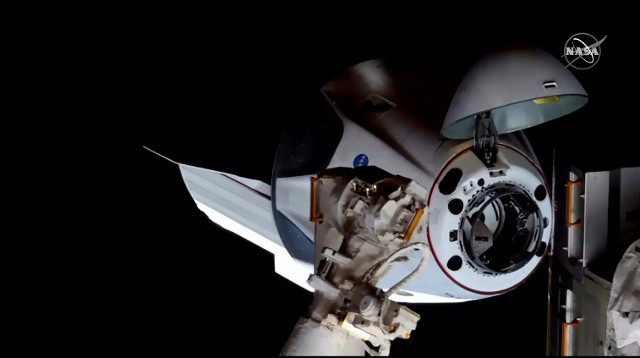
The Soyuz MS-16 spacecraft docking with the International Space Station (Image NASA TV)

A little while ago the Soyuz MS-16 spacecraft was launched from the Baikonur Cosmodrome in Kazakhstan and after a little more than six hours reached the International Space Station with three astronauts on board. In the period preceding a launch, it’s normal for astronauts and cosmonauts to remain in quarantine. In this case it was also extended to the personnel who managed the launch, with limits to the people who could have been in Baikonur.

The Dragon cargo spacecraft departing International Space Station to end its CRS-20 mission (Image NASA TV)

A few hours ago the SpaceX Dragon spacecraft ended its CRS-20 (Cargo Resupply Service 20) mission for NASA splashing down smoothly in the Pacific Ocean a bit more than 800 kilometers (about 500 miles) off the coast of California. The Dragon left the International Space Station yesterday. For SpaceX, this is the conclusion of the first contract with NASA to transport resupplies to the Station with the first version of the Dragon cargo spacecraft.

Shortly after landing, SpaceX boats went to retrieve the Dragon to transport it to the coast. The cargo brought back to Earth will be delivered to NASA soon, probably tomorrow. The Dragon spacecraft reached the International Space Station on March 9, 2020.

Artist's concept of the Dragon XL cargo spacecraft after separating from the Falcon Heavy rocket's second stage (Image courtesy SpaceX)

NASA has announced that it has selected SpaceX as the first supplier in the Gateway Logistics Services contract to transport cargo, experiments and other supplies to the Lunar Gateway, part of the Artemis program that aims to bring astronauts back to the Moon. At least two missions will be carried out with the Dragon XL cargo spacecraft, a new variant of the Dragon 2 cargo optimized to carry over 5 metric tons of cargo to the Moon’s orbit. The timeline for these missions isn’t clear due to the NASA’s changes of plans, as recently the agency decided to skip the use of the Lunar Gateway for the mission that’s supposed to take place by 2024 and use it in the following years.

Uranus seen by Voyager 2 (Image NASA/JPL-Caltech)

An article published in the journal “Geophysical Research Letters” reports the discovery of a plasmoid, a structure composed of plasma formed mainly of hydrogen in the midst of magnetic fields, in the magnetotail – the magnetosphere’s tail – of the planet Uranus that was moving away from it. The plasmoid’s formation isn’t a new event because Gina DiBraccio and Daniel J. Gershman of NASA’s Goddard Space Flight Center examined the observations made by the Voyager 2 space probe during the its Uranus flyby on January 24, 1986. It’s the first plasmoid discovered in the Uranus’ atmosphere and could be a crucial mechanism for its loss of atmosphere.