NASA

The Dragon cargo spacecraft blasting off for its CRS-20 mission atop a Falcon 9 rocket (Photo NASA)

A few hours ago the SpaceX Dragon spacecraft blasted off atop a Falcon 9 rocket from Cape Canaveral in its CRS-20 (Cargo Resupply Service 20) mission, also referred to as SPX-20. After just over ten minutes it separated successfully from the rocket’s last stage and went en route. This is the 20th mission for the Dragon spacecraft to resupply the International Space Station with various cargoes and then return to Earth, again with various cargoes. It’s the last mission for this Dragon version, which will be replaced by Dragon 2 from the next mission.

Jupiter's equatorial region

An article published in the journal “Nature Astronomy” reports a study on the abundance of water in the atmosphere and in particular in the equatorial region of the planet Jupiter. NASA’s Juno mission team used data collected by the space probe, which has been orbiting the gas giant for about 3.5 years. The conclusion is that water makes up about 0.25% of the molecules in Jupiter’s atmosphere, about three times those present in the Sun’s atmosphere estimated through the presence of its components. This is a result that indicates an abundance much higher than that measured in 1995 by the Galileo space probe.

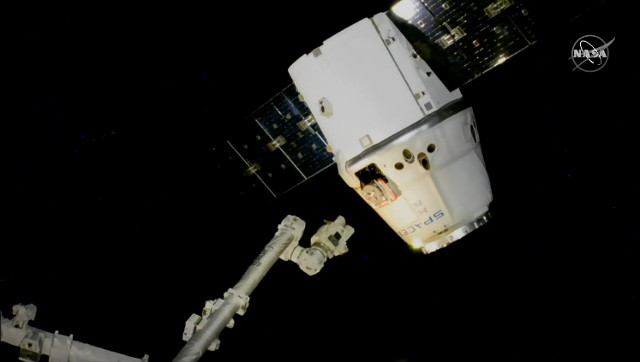
The Cygnus "Robert Lawrence" cargo spacecraft captured by the Canadarm2 robotic arm (Image NASA TV)

Northrop Grumman’s Cygnus spacecraft, launched last Saturday, February 15, has just reached the International Space Station and was captured by the Canadarm2 robotic arm. Astronaut Andrew Morgan, assisted by his colleague Jessica Meir, will soon begin the slow maneuver to move the Cygnus until it docks with the Station’s Unity module after about two hours.

Arrokoth (Image NASA/Johns Hopkins University Applied Physics Laboratory/Southwest Research Institute/Roman Tkachenko)

Three articles published in the journal “Science” report various aspects of a research on the origins and characteristics of Arrokoth, the Kuiper Belt object classified as 2014 MU69 and for some time known by the nickname Ultima Thule. Different teams of researchers with various members in common used data collected by NASA’s New Horizons space probe to study it from various points of view. One of the conclusions concerns its origin, which might have occurred following the collapse of a cloud of solid particles in the primordial solar nebula and not following the process known as hierarchical accretion, a process that has high-speed collisions between planetesimals.