NASA

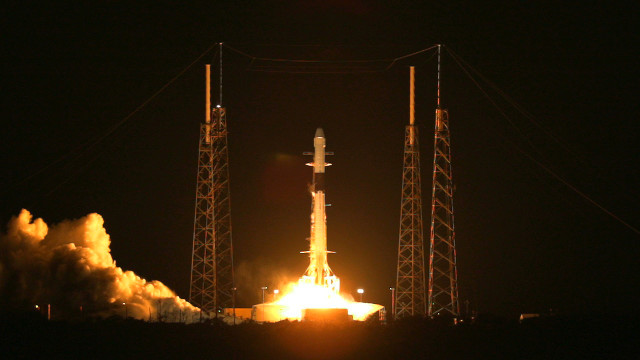
The Cygnus cargo spacecraft blasting off atop an Antares rocket to start its NG-13 mission (Image NASA TV)

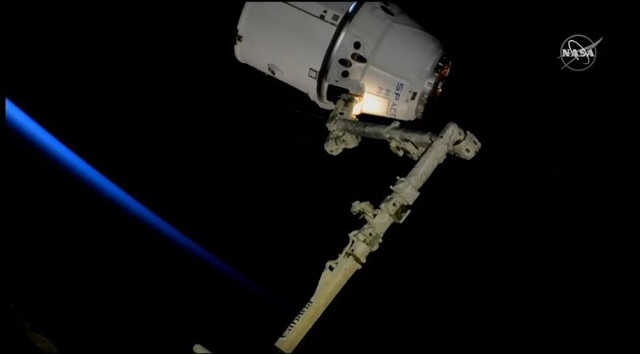
A little while ago Northrop Grumman’s Cygnus spacecraft blasted off atop an Antares rocket from the Mid-Atlantic Regional Spaceport (MARS), part of NASA’s Wallops Flight Facility (WFF) on Wallops Island. After about nine minutes it successfully separated from the rocket’s last stage went en route to its destination. This is its 13th official mission, called NG-13 or CRS NG-13, to transport supplies to the International Space Station for NASA.

The Solar Orbiter space probe blasting off atop an Atlas V rocket (Photo ESA - S. Corvaja)

A few hours ago the Solar Orbiter space probe blasted off atop an Atlas V rocket from Cape Canaveral. After about 53 minutes, it successfully separated from the rocket’s last stage and began the long journey that will take it up to about 42 million kilometers from the Sun. A little later it deployed its solar panels and started communicating with the mission control center.

Pluto

An article published in the “Journal of Geophysical Research” reports a study on the dwarf planet Pluto and in particular on the heart-shaped region called Tombaugh Regio and its influence on global atmospheric circulation. A team of researchers coordinated by NASA’s Ames Research Center used data collected by the New Horizons space probe to specifically study nitrogen circulation and its cycle appropriately compared to a heart beat. This is another confirmation that Pluto is an active small world despite its small size and thin atmosphere.

Christina Koch, Alexander Skvortsov and Luca Parmitano assisted after their landing (Image NASA TV)

A little while ago astronauts Luca Parmitano and Christina Koch and cosmonaut Alexander Skvortsov returned to Earth on the Soyuz MS-13 spacecraft, that landed in Kazakhstan. Parmitano and Skvortsov spent a bit more than 6 months on the International Space Station, where they arrived on July 20, 2019 as part of Expedition 60, while Christina Koch arrived on March 15, 2019 as part of Expedition 59 and accomplished a long mission.

The Spitzer space telescope being prepared (Photo NASA)

NASA’s Spitzer space telescope ended its mission with its final shutdown, which happened when in the USA it was afternoon. Launched on August 15, 2003, it’s been an instrument crucial for infrared astronomy in studies of various kinds ranging from those of solar system’s objects to those of distant galaxies passing through those of exoplanets.