NASA

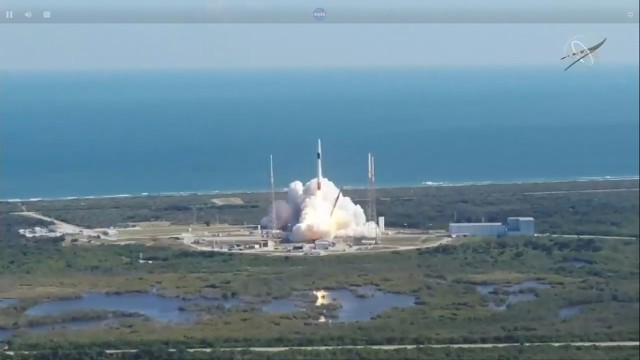
The Dragon cargo spacecraft blasting off atop a Falcon 9 rocket (Image NASA TV)

A little while ago the SpaceX Dragon spacecraft blasted off atop a Falcon 9 rocket from Cape Canaveral in its CRS-19 (Cargo Resupply Service 19) mission, also referred to as SPX-19. After just over ten minutes it separated successfully from the rocket’s last stage and went en route. This is the 19th mission for the Dragon spacecraft to resupply the International Space Station with various cargoes and then return to Earth, again with various cargoes.

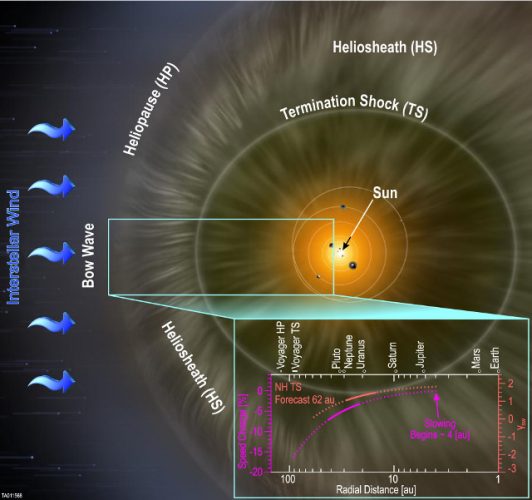
Slowing of the solar wind in the outer solar system

An article published in “The Astrophysical Journal” reports a study on changes in the solar wind in the outer region of the heliosphere, the bubble in which the influence of the Sun is felt. A team of researchers from the Southwest Research Institute led by Dr. Heather Elliott used measurements collected by NASA’s New Horizons space probe’s Solar Wind Around Pluto (SWAP) instrument to compare the speed of the solar wind at distances from the Sun between 1 and 3 times that of the Earth from the Sun and at distances between 21 and 43 times that distance reveals a slowdown between 5% and 7% at distances between 30 and 43 times that of the Earth from the Sun.

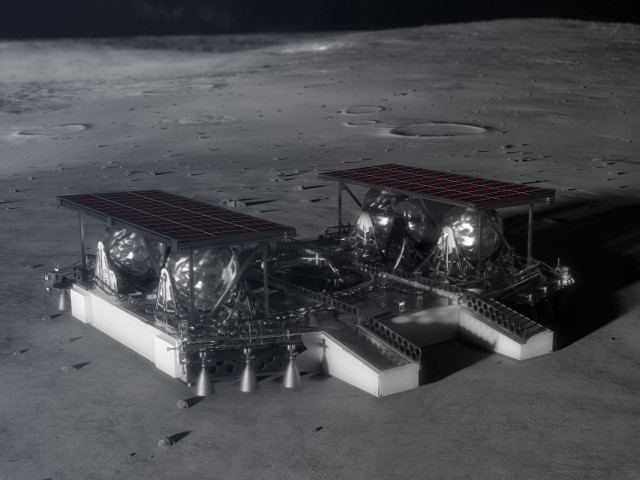
Artist's concept of lander on the Moon's surface (Image NASA)

NASA presented a medium-sized lunar lander concept that could be used during missions in the next few years within the Artemis program. The aim is to bring human beings back to the Moon, but manned missions involve a series of scientific studies with the aim of creating a stable base. Various scientific instruments and rovers will be needed that can make explorations on the lunar surface, payloads that can be brought to the surface by a lander of a type compared to a pallet. A technical publication of the concept offers references for the industries that collaborate with NASA.

Artist's concept of Starship with lander on the Moon (Image courtesy SpaceX)

NASA has announced the selection of five more companies within the program called Commercial Lunar Payload Services (CLPS). They’re added to the ones announced in November 2018 for a total of 14 companies that will be eligible to bid on proposals to provide services to send various types of cargoes to the Moon. They’re support services to the Artemis program which aims to send humans back to the Moon. There’s the well-known SpaceX, another company that already has contracts with NASA such as Sierra Nevada Corporation, an ambitious company that has yet to show what it can do such as Blue Origin and two lesser known companies such as Ceres Robotics and Tyvak Nano-Satellite Systems Inc.

Oxygen spikes in Mars atmosphere are a new mystery

An article published in the “Journal of Geophysical Research: Planets” reports an analysis of the composition of the atmosphere of the planet Mars based on data collected by NASA’s Mars Rover Curiosity. A team of researchers led by Melissa Trainer of NASA’s Goddard Space Center confirmed the presence of various gases already known with seasonal variations due to carbon dioxide’s freezing and evaporation. A surprise came from the detection of a remarkable growth of oxygen in spring and its drop back to the previous levels in fall. This is a new mystery added to that of the presence of methane on the red planet.