
NASA

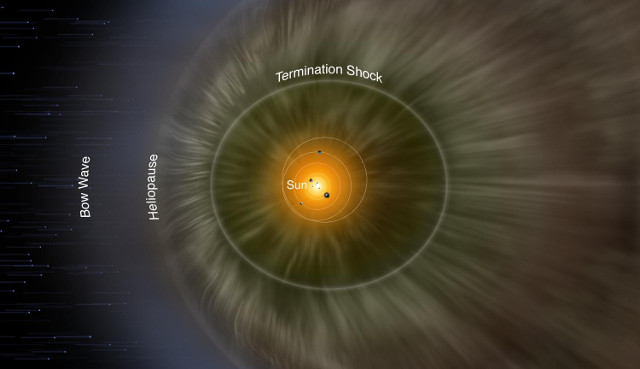
Illustration of the heliosphere (Image NASA/IBEX/Adler Planetarium)

A team of scientists led by Jamie Rankin of Princeton used measurements of the galactic cosmic rays detected by NASA’s Voyager space probes to obtain an estimate of the total pressure that plasma, magnetic fields and various particles exert on each other in the heliosheath, the outer region of the heliosphere, the big bubble around the Sun where solar wind exerts its influence. The result is higher than expected and will help to better understand the interactions between the Sun and its surroundings.

Traces of ancient salty ponds at the bottom of Gale Crater on Mars

An article published in the journal “Nature Geoscience” reports the results of an analysis of data collected by the Mars Rover Curiosity in a section of sedimentary rocks of Gale Crater on Mars called Sutton Island where salt was detected in the form of mineral salt in the sediments. A team of researchers led by William Rapin of Caltech interpreted that presence as evidence that about 3.5 billion years ago there were salty ponds that went through episodes of overflow and drying. The deposits show the history of climatic fluctuations in the period in which the Martian environment passed from wet and similar to the Earth to today’s dry desert.

Nick Hague, Alexey Ovchinin and Hazzaa Ali Almansoori assisted after their landing (Image NASA TV)

A few hours ago astronaut Nick Hague and cosmonaut Alexey Ovchinin returned to Earth on the Soyuz MS-12 spacecraft, that landed in Kazakhstan. The Soyuz MS-12 landed on its side but that created no problems to its crew. The two of them spent a bit more than 6 months on the International Space Station, where they arrived on March 15, 2019 as part of Expedition 59. Together with them there was Hazzaa Ali Almansoori, who spent 8 days on the Station.