NASA

Some views of the rock Cheyava Falls with spectroscopic results (d) from the examination of samples from the area

An article published in the journal “Nature” reports the results of the analysis of data collected by NASA’s Mars Rover Perseverance on the rock nicknamed Cheyava Falls. Perseverance found it in 2024 in the Neretva Valley during its journey within the Jezero Crater on Mars. The rock immediately attracted great interest because it contains chemical signatures and structures that could have been generated by ancient Martian life forms.

A team of researchers confirmed the exciting results presented last year and concluded that these are potential biosignatures. This means they provide clues to the possible presence of Martian life forms in the past, but further studies are needed to obtain definitive answers. In fact, the presence of organic compounds and iron minerals such as vivianite and greigite could also be due to abiotic reactions.

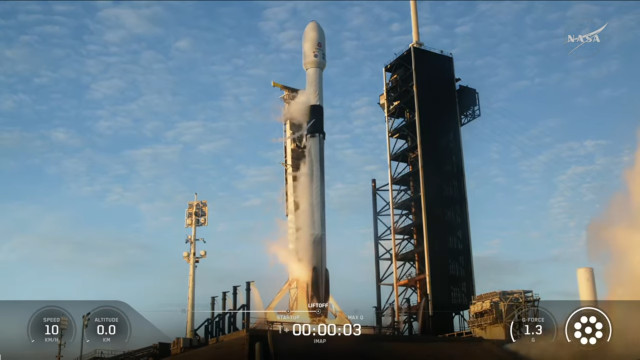
The Dragon 2 cargo spacecraft blasting off atop a Falcon 9 rocket in its CRS-33 rocket (Image NASA+)

A little while ago, the SpaceX Dragon 2 spacecraft blasted off atop a Falcon 9 rocket from Cape Canaveral in its CRS-33 (Cargo Resupply Service 33) mission, also referred to as SPX-33. After almost 12 minutes, it separated successfully from the rocket’s last stage and went en route. This is the 33rd mission for the Dragon/Dragon 2 spacecraft to resupply the International Space Station with various cargoes and then return to Earth, again with various cargoes.

The Crew Dragon Endurance spacecraft after splashing down at the end of its Crew-10 mission (Image NASA+)

A little while ago, SpaceX’s Crew Dragon Endurance spacecraft completed its Crew-10, or SpaceX Crew-10, mission for NASA with a successful splashdown. Aboard were astronauts Anne McClain, Nichole Ayers, and Takuya Onishi, and cosmonaut Kirill Peskov, who had arrived at the International Space Station on March 16, 2025, as part of Expedition 72/73. The Crew-10 members completed SpaceX’s 10th regular crewed mission in the Pacific Ocean, off the coast of California. The Crew Dragon had left the Station approximately 17.5 hours earlier.

The Crew Dragon Endurance spacecraft docked with the Harmony module of the International Space Station in its Crew-11 mission (Image NASA+)

A little while ago, SpaceX’s Crew Dragon Endurance spacecraft docked with the Harmony module of the International Space Station, completing the first part of its Crew-11 or SpaceX Crew-11 mission that began with its launch about 15.5 hours earlier. After checking that the pressure gets properly balanced, the hatch will be opened to allow Oleg Platonov, Mike Fincke, Kimiya Yui, and Zena Cardman to enter the Station and start their mission, which could last even 8 months.