NASA

The TRACERS satellites blasting off atop a Falcon 9 rocket (Image SpaceX)

A few hours ago, NASA’s two TRACERS satellites were launched atop a SpaceX Falcon 9 rocket from the Vandenberg Air Force Base. After about an hour and 40 minutes, they successfully separated from the rocket’s last stage to begin the maneuvers that will place them in a Sun-synchronous orbit at an altitude of 600 kilometers.

The two TRACERS (Tandem Reconnection and Cusp Electrodynamics Reconnaissance Satellites) twin satellites join other space missions aimed at studying the Sun and its interactions with the Earth. The PUNCH mission was launched on March 12, and on March 15, the three CubeSat-class nanosatellites of the EZIE (Electrojet Zeeman Imaging Explorer) mission were launched. EZIE’s goal is to study changes in electrical currents moving through the upper layers of Earth’s atmosphere in the polar regions.

The Crew Dragon Grace spacecraft after splashing down (Image courtesy Axiom Space)

A little while ago, SpaceX’s Crew Dragon Grace spacecraft concluded its Ax-4 mission by splashing down without problems. On board were Shubhanshu Shukla, Peggy Whitson, Sławosz Uznański-Wiśniewski, and Tibor Kapu, who ended this completely private space mission in the Atlantic Ocean after leaving the International Space Station almost 48 hours earlier. Shortly after splashing down, SpaceX’s recovery ship went to retrieve the Grace and its crew to transport them to the coast.

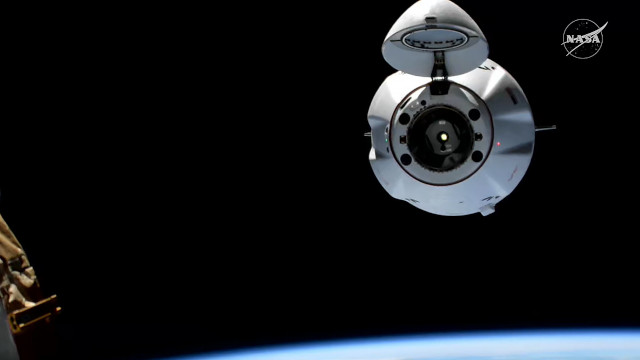
A few hours ago, SpaceX’s Dragon spacecraft ended its CRS-32 (Cargo Resupply Service 32) mission for NASA splashing down smoothly off the coast of California. The Dragon left the International Space Station about 36 hours earlier. For SpaceX, this was the 12th mission of the 2nd contract with NASA to transport supplies to the Station with the new version of the Dragon cargo spacecraft. The Dragon spacecraft had reached the International Space Station on April 22.

The Dragon 2 cargo spacecraft blasting off atop a Falcon 9 in its CRS-32 mission (Image NASA+)

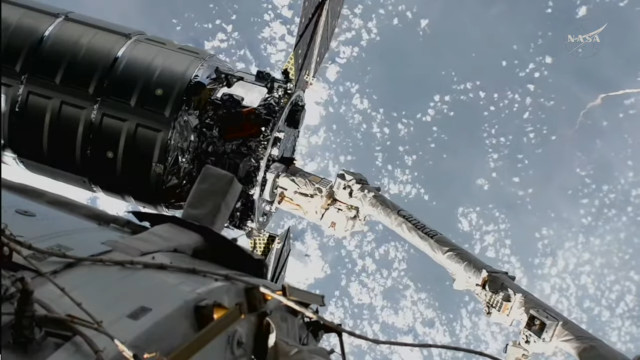
A little while ago, the SpaceX Dragon 2 spacecraft blasted off atop a Falcon 9 rocket from Cape Canaveral in its CRS-32 (Cargo Resupply Service 32) mission, also referred to as SPX-32. After almost 10 minutes, it separated successfully from the rocket’s last stage and went en route. This is the 32nd mission for the Dragon/Dragon 2 spacecraft to resupply the International Space Station with various cargoes and then return to Earth, again with various cargoes.