NASA

Mars Rover Curiosity and the Apollo 17's Moon Rover (Image NASA/JPL-Caltech)

An article published in the journal “Science” reports a clever use of the Mars Rover Curiosity’s accelerometers and gyroscopes to estimate the density of rocks under Gale Crater. A team of scientists examined the data collected over the years by those instruments to evaluate the gravity force where Curiosity passed, obtaining lower than expected measurements. This suggests that in that area the rocks are very porous and less compact than scientists thought.

Some details on the geology of Ultima Thule

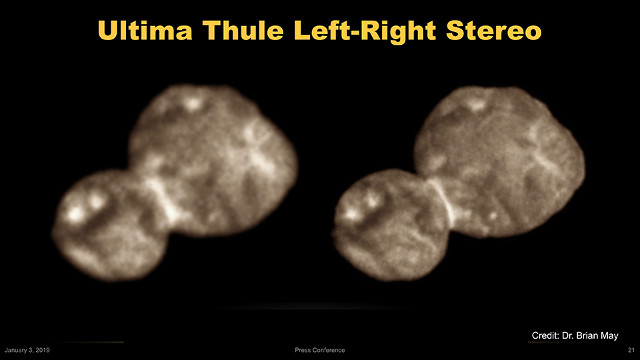
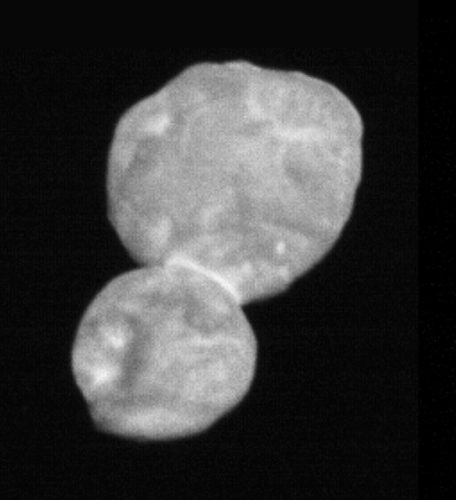
The Johns Hopkins University Applied Physics Laboratory, which collaborates with NASA at the New Horizons mission, has published a new image of the Kuiper Belt Object cataloged as 2014 MU69 and nicknamed Ultima Thule which offers more details of its geological features. Various pits, the great depression on the smallest lobe, the “collar” that joins the two lobes, clear and dark features will be studied to get answers to the many questions posed after receiving the first images taken by the space probe in its New Year’s Day 2019 flyby.

The Dragon cargo spacecraft departing the International Space Station to end its CRS-16 mission (Image NASA TV)

A little while ago the SpaceX Dragon spacecraft ended its CRS-16 (Cargo Resupply Service 16) mission for NASA splashing down smoothly in the Pacific Ocean a little more than 420 kilometers (about 326 miles) off the coast of California. The Dragon left the International Space Station a few hours earlier.

Shortly after landing, SpaceX boats went to retrieve the Dragon to transport it to the coast. The cargo brought back to Earth will be delivered to NASA soon, probably tomorrow. The Dragon spacecraft reached the International Space Station on December 8, 2018.

Ultima Thule offers the first answers but leaves many questions open

In a press briefing that included a number of scientists working on NASA’s New Horizons mission, the first discoveries on the Kuiper Belt object cataloged as 2014 MU69 and nicknamed Ultima Thule were presented, obtained thanks to data received during the January 1, 2019 flyby. They’re based on information that’s still incomplete, which could be contradicted by high resolution photos and other data but for the moment this object doesn’t appear to have neither moons nor rings, or at least not of relevant sizes, no impact craters were found on its surface nor were traces of atmosphere.

Ultima Thule is made up of two smaller asteroids

NASA published the first detailed images of the Kuiper Belt object cataloged as 2014 MU69 and nicknamed Ultima Thule. Captured by the New Horizons space probe’s LORRI and MVIC instruments approximately 90 to 30 minutes before its closest approach, they finally clearly show this object’s double-lobe structure. In jargon, it’s called a contact binary and is the result of two close objects that collide at low speed and end up merging. The larger lobe has been nicknamed Ultima and the smaller Thule.