NASA

Image captured by Machines’ Nova-C Athena lander during its descent (Image courtesy Intuitive Machines / NASA)

A little while ago, Intuitive Machines’ Nova-C Athena lander attempted its Moon landing in the Mons Mouton area. This was an autonomous maneuver that was the key step in the IM-2 mission. In the minutes following the end of the maneuver, signals started arriving at mission control with increasing clarity. This allowed them to start understanding Athena’s situation.

Graphic representation of the Blue Ghost M1 lander on the Moon (Image courtesy NASA / Firefly Aerospace)

A little while ago, Firefly Aerospace’s Blue Ghost lander attempted a Moon landing in Mare Crisium. This was an autonomous maneuver that was the key step in what is known as Mission 1. After completing its braking and touching down on the Moon’s surface, Blue Ghost sent signals from its sensors confirming its success. After just over half an hour, it started sending images of the Moon’s surface.

The Nova-C Athena Moon lander and the Lunar Trailblazer satellite blasting off atop a Falcon 9 rocket (Image courtesy Intuitive Machines)

A few hours ago, the Nova-C Athena Moon lander blasted off atop a SpaceX Falcon 9 rocket from Kennedy Space Center on Intuitive Machines’ IM-2 mission. After about 48 minutes, it successfully separated from the rocket’s last stage and set off on a course to the Moon, where it’s scheduled to attempt a landing on March 6. About 3 minutes later, NASA’s small Lunar Trailblazer satellite also separated from the rocket’s second stage, but its course is very different from Athena’s, so it will not reach the Moon until June.

ispace's Hakuto-R2 Resilience and Firefly Aerospace's Blue Ghost Moon landers blasting off atop a Falcon 9 rocket (Image courtesy SpaceX)

A little while ago, ispace’s Hakuto-R2 Resilience and Firefly Aerospace’s Blue Ghost Moon landers blasted off atop a Falcon 9 rocket from Cape Canaveral. After about 1 hour and 5 minutes, Blue Ghost successfully separated from the rocket’s upper stage, and about 27 minutes later, Resilience separated as well. The two landers will travel on very different routes to attempt to land on the Moon a few months apart. This is ispace’s second mission, after the first failed on April 25, 2023.

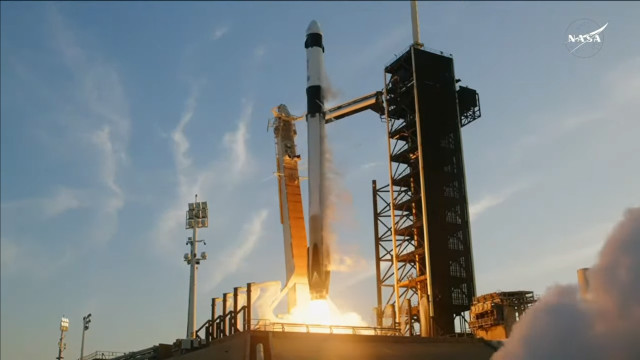
The Dragon cargo spacecraft as seen by astronaut Don Pettit while departing the International Space Station to end its CRS-31 mission

A few hours ago, SpaceX’s Dragon spacecraft ended its CRS-31 (Cargo Resupply Service 31) mission for NASA splashing down smoothly off the Florida Coast. The Dragon left the International Space Station about 24 hours earlier. For SpaceX, this was the 11th mission of the 2nd contract with NASA to transport supplies to the Station with the new version of the Dragon cargo spacecraft.

Shortly after the splashdown, SpaceX’s “MV Megan” recovery ship went to retrieve the Dragon to transport it to the coast. The cargo brought back to Earth will be delivered to NASA within a few hours. The Dragon spacecraft reached the International Space Station on November 5, 2024.