NASA

Illustration of a hot Jupiter planet with its clouds (Image NASA/JPL-Caltech)

An article published in “The Astrophysical Journal” describes a research about the possible presence of water in the planets of the type called hot Jupiter. Those are gas giants just like Jupiter but orbit very close to their stars and consequently have very high surface temperatures. A team of scientists at NASA’s JPL led by Aishwarya Iyer tried to understand why the atmosphere of some hot Jupiters doesn’t seem to contain water.

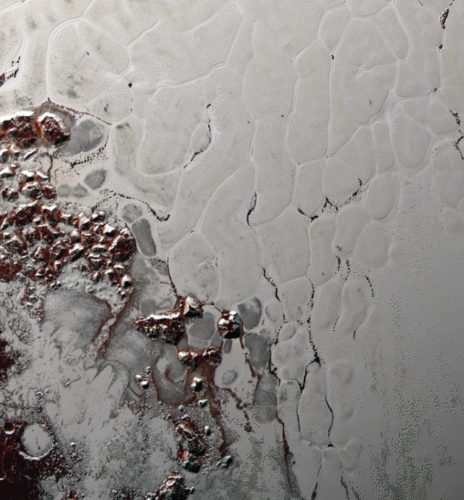
An area about 400 km (250 miles) long in Pluto's Sputnik Planum region (Image NASA/JHUAPL/SwRI)

Two articles published in the journal “Nature” describe a research about the heart-shaped geological formation on the dwarf planet Pluto. NASA’s New Horizons mission scientists determined various characteristics of the area, informally called Sputnik Planum, explaining that a phenomenon called convection renews its surface over time. Using the images taken by the New Horizons space probe, another research revealed new details on Pluto’s atmosphere.

Representation of a solar superflare (Image NASA's Goddard Space Flight Center, Greenbelt, Md.)

An article published in the journal “Nature Geoscience” describes a study on the relationship between super solar flares of a few billion years ago and the emergence of life forms on Earth. According to a team of NASA scientists led by Vladimir Airapetian those gigantic storms provided the energy needed to warm up the Earth and to trigger some chemical reactions needed to form complex molecules such as RNA and DNA on which life is based.

Artistic representation of a supermassive black hole seed. The inset boxes show a candidate seen by Chandra (top) and by Hubble (bottom) (Image X-ray: NASA/CXC/Scuola Normale Superiore/F. Pacucci, et al. Optical: NASA/STScI. Illustration: NASA/CXC/M. Weiss)

An article that will be published in the journal “Monthly Notices of the Royal Astronomical Society” describes a research on the origin of supermassive black holes. A team of Italian scientists led by Fabio Pacucci of Scuola Normale Superiore of Pisa used NASA’s space telescopes to identify two ancient objects that represent the best candidates black hole “seeds” found so far.

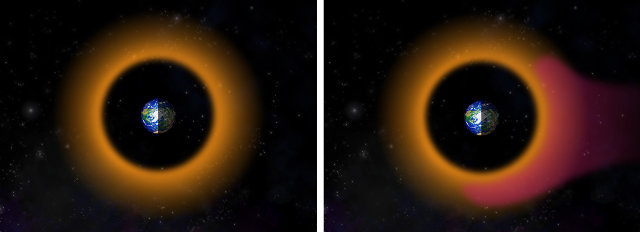
The ring current during quiet time (left) and during a geomagnetic storm (right) (Image Johns Hopkins APL)

An article published in the journal “Geophysical Research Letters” describes a research on the behavior of the ring of particles that surrounds the Earth. Using the measurements taken by the RBSPICE instrument aboard one of NASA’s Van Allen space probes it was possible to establish that high-energy protons in the ring current behave completely different from low-energy protons. It’s a step forward in the understanding of the Earth’s magnetosphere and therefore of the effects it may have on satellites and even the Earth’s surface.