NASA

Artistic illustration of the Kepler Space Telescope (Image NASA)

NASA announced that it succeeded in restoring the Kepler space telescope after a few days it entered Emergency Mode. The mission’s engineers restored the communications during the last Sunday but the time table to resume its work is still to be determined. Communications also made it possible to start downloading telemetry and event data to determine the causes of the emergency.

The Dragon spacecraft captured by the International Space Station's robotic arm (Image NAAS TV)

A little while ago the SpaceX Dragon spacecraft was captured by the robotic arm Canadarm2 on the International Space Station. Tim Peake, assisted by his fellow astronaut Jeff Williams, managed the operation and started moving the Dragon to the berthing point at the Harmony module. The spacecraft was launched last Friday and arrived a little more than 20 minutes later than scheduled because it was slowed down by atmosphere drag but eventually the first leg of its mission was accomplished.

SpaceX Dragon cargo spacecraft blasting off atop a Falcon 9 rocket in the CRS-8 mission (Image NASA TV)

A few hours ago SpaceX Dragon spacecraft blasted off on a Falcon 9 rocket from Cape Canaveral in its CRS-8 (Cargo Resupply Service) mission, also referred to as SPX-8. After about twelve minutes it successfully separated from the rocket’s last stage and went en route. This is the 8th of 12 missions that include sending the Dragon spacecraft to the International Space Station with various cargoes and then return to Earth, again with various cargoes.

Titan with Sinlap crater in the pane seen at different wavelengths (Image NASA/JPL-Caltech/University of Arizona/LPGNantes)

At the 47th Lunar and Planetary Science Conference held last week in The Woodlands, Texas, the latest news about the mountains of Titan, the largest of Saturn’s moons, were presented. NASA also presented the progress made in creating maps of this moon, a task that has to face a number of problems. All these works are based on data collected by the Cassini space probe.

Color global map of Ceres (Image NASA/JPL-Caltech/UCLA/MPS/DLR/IDA)

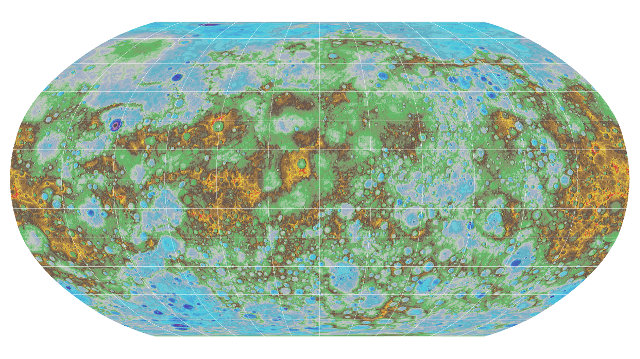
At the 47th Lunar and Planetary Science Conference held last week in The Woodlands, Texas, new results were presented of the analyzes of data collected about the dwarf planet Ceres by NASA’s Dawn space probe. Some of the mission scientists presented a new color map of Ceres surface and new highly detailed pictures of Occator crater, famous for the presence of the largest among the white spots, but also other interesting craters, especially Oxo, where water was found.