

NASA

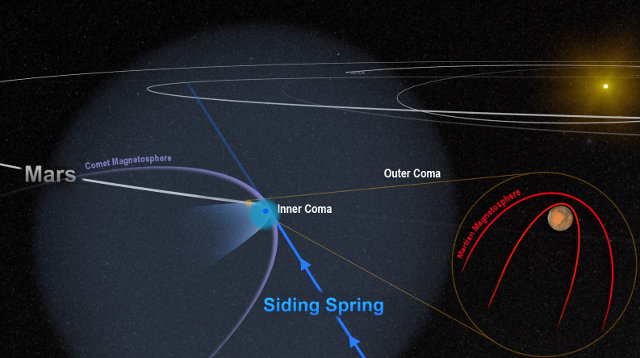
Mars’ magnetosphere was thrown into chaos by the comet C/2013 A1 Siding Spring
An article published in the journal “Geophysical Research Letters” describes the effects on the planet Mars’ magnetic field caused by the close passage of the comet C/2013 A1 Siding Spring in October 2014. Using data collected in that period by NASA’s MAVEN space probe it was possible to reconstruct the moments that were chaotic for the Martian magnetosphere with profound consequences even if temporary.


The mystery of Ahuna Mons on Ceres
Between March 6 and 7, 2015, depending on your time zone on Earth, NASA’s Dawn space probe entered the orbit of the dwarf planet Ceres. In December 2015 it went down to a lower altitude to conduct a mapping with the best definition and in February 2016 its orbital path led it into a position where it could take excellent pictures of Ahuna Mons, as they called the mountain that used to look like a pyramid and is one of the most curious geological features on Ceres.


The return of three astronauts from the International Space Station marks the end of Expedition 46
A few hours ago, the cosmonauts Sergey Volkov and Mikhail Kornienko and the American astronaut Scott Kelly returned to Earth on the Soyuz TMA-18M spacecraft, landed without problems in Kazakhstan. Volkov spent about six months on the International Space Station, where he arrived on September 4, 2015 as part of Expedition 45. Kornienko and Kelly spent 340 days on the Station, where they arrived on March 28, 2015 as part of Expedition 43.

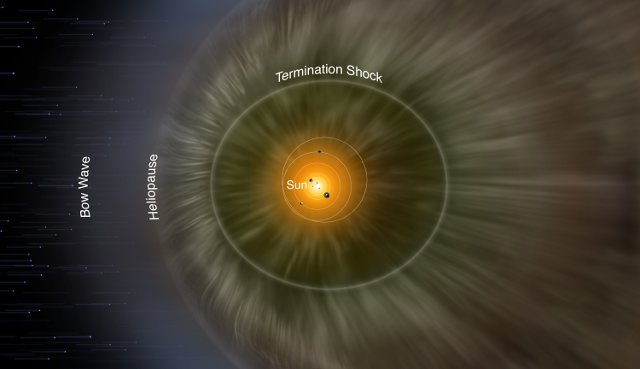
New discoveries reveal interstellar magnetic field
An article published in the journal “Astrophysical Journal Letters” describes a study that used data from NASA’s IBEX space probe and various simulations of the boundary of the magnetic bubble called the heliosphere, created by the flow of particles emitted by the Sun, to improve our knowledge of the interstellar magnetic field. In particular, this study sought to determine the strength and direction of the magnetic field outside the heliosphere to understand the forces acting in the galactic neighborhood.
