NASA

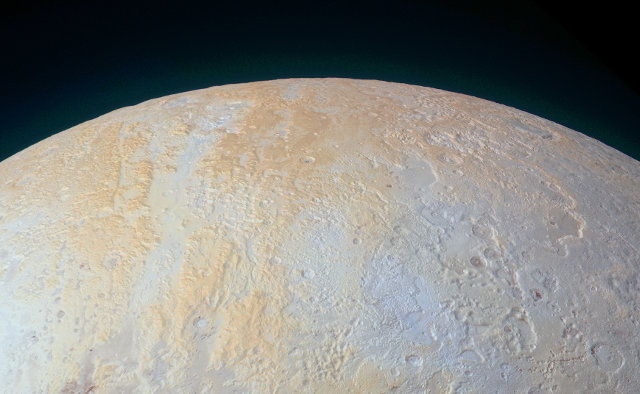
Maps of water ice on Pluto's surface (Image NASA/JHUIAPL/SwRI)

In recent months we go used to seeing the extraordinary photographs of the dwarf planet Pluto and its moons taken by NASA’s New Horizons space probe during its July 14, 2015 flyby but there are other instruments on board that were used to make various detecions. Like the photos, the data collected will keep on being sent for several more months. Those received so far by NASA have uncovered a presence of water ice greater than anticipated and allowed us to see the atmosphere of Pluto at infrareds.

Image of Hinners Point, an area of Marathon Valley, obtained combining six photos taken by the Mars Rover Opportunity (Image NASA/JPL-Caltech/Cornell Univ./Arizona State Univ.)

The Mars Rover Opportunity landed on Mars January 25, 2004 at 05.05 UTC. Its mission went far beyond all expectations and after a few years we started taking it for granted. In 2010, the loss of its sister, the Mars Rover Spirit, reminded us that space missions are conducted in unforgiving environments and any problem can be fatal.

The Opportunity mission controllers tried to preserve the rover placing it on a sloping terrain during the Martian winters so that its solar panels can receive the most possible sunlight. Unfortunately, other problems have been limiting its efficiency for a long time.

Illustration of our traditional view of the Van Allen belts (Image NASA Goddard/Duberstein)

An article published in “Journal of Geophysical Research” describes a study on the Van Allen belts, two donut-shaped energetic formations surrounding the Earth. Two twin spacecraft originally called the Radiation Belt Storm Probes (RBSP) and later Van Allen probes were launched by NASA on August 30, 2012 to study the belts and are allowing us to learn a lot about them. The latest discovery concerns the variability of their shape.

The Jason-3 satellite right after blasting off atop a Falcon 9 rocket (Photo NASA/Bill Ingalls)

It was morning in California when the Jason-3 satellite was launched on a SpaceX Falcon 9 rocket from the Vandenberg U.S. Air Force Base. After nearly an hour it separated from the rocket’s upper stage and started deploying its solar panels. It will operate from a low Earth orbit of polar type, which means that it will pass over the poles, with an altitude between 1,328 and 1,380 kilometers (825 to 860 miles).

Artistic concept of the Dream Chaser Cargo System docked with the International Space Station (Image courtesy Sierra Nevada Corporation. All rights reserved)

NASA announced the companies selected for the new contracts for cargo transport to the International Space Station. This is the second selection so the agency calls them CRS-2 (Commercial Resupply Services 2) and concern the transport of supplies as well as the disposal of waste or otherwise of what is no longer needed and the transport of cargo from the Station to return it to NASA. This time the agency selected three companies reneweing the contracts with SpaceX and Orbital ATK and also selecting Sierra Nevada Corporation.