Planets

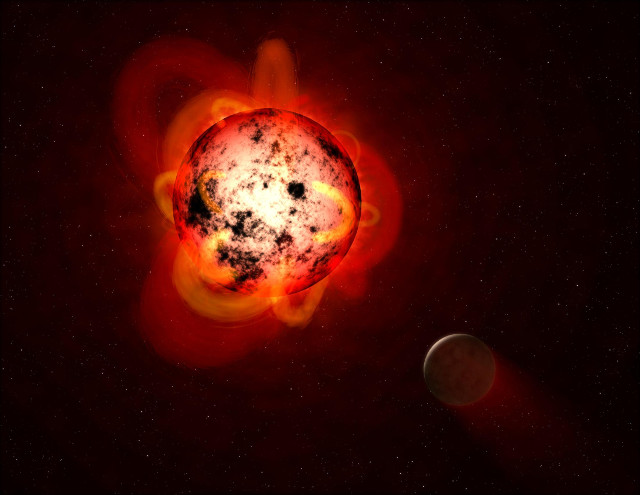
Artist's concept of a rocky planet's atmosphere being stripped by a red dwarf's flares

An article published in “The Astrophysical Journal Letters” reports a study on the exoplanet GJ 1252b which concludes that it has no atmosphere. In particular, a team of researchers used data collected by the Spitzer Space Telescope to examine this rocky planet which is about 20% larger than the Earth with a mass that is about 32% larger than the Earth’s. GJ 1252b orbits a red dwarf and according to the researchers, this star stripped this super-Earth’s atmosphere. This is due to the fact that red dwarfs are small but very active stars and confirms that it may be difficult to find a habitable planet around this type of star.

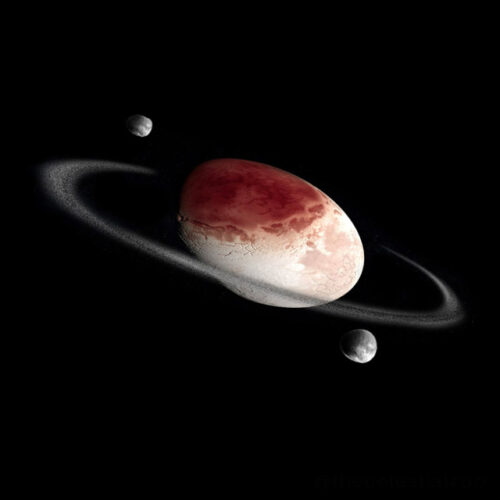
An artistic representation of Haumea with its moons Hiʻiaka and Namaka, which are actually much farther away from it, and its ring

An article published in the “Planetary Science Journal” reports the results of simulations that reproduce the possible history of the dwarf planet Haumea that led to its peculiar oval shape. A team of researchers used the geophysical and geochemical data available on Haumea and the asteroids that form a family with this dwarf planet to understand what processes led to their formation and evolution. The simulations lead to a reconstruction of the process that resulted in Haumea’s remarkable fast spin, which in turn led to its present shape.

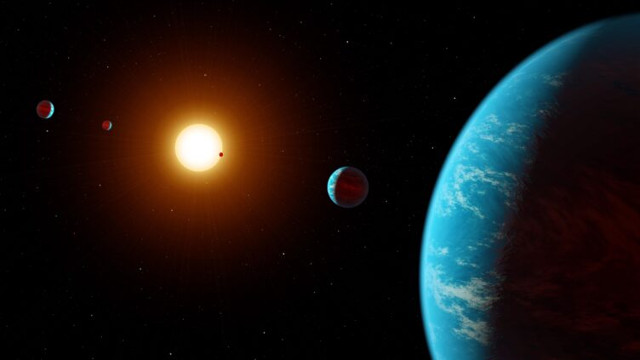
Artist's concept of a 5-Exoplanet system (Image NASA/JPL-Caltech))

An article published in the journal “Astronomy & Astrophysics” reports the confirmation of the presence of 5 rocky planets in the HD 23472 star system. A team of researchers used the Espresso spectrograph on ESO’s VLT to examine these exoplanets to estimate their masses using the radial velocity method. Their sizes were already known thanks to the data collected by NASA’s TESS space telescope, which observed their transit in front of their star. The result of the examination is that three of those exoplanets are super-Earths and two are probably super-Mercuries, rare cases characterized by a larger iron core and in general a high percentage of iron.

A topographic map of Ultimi Scopuli's area on Mars

An article published in the journal “Nature Communications” offers new confirmation of the presence of very salty liquid water on Mars underground. A team of researchers led by Roberto Orosei of the Italian National Institute of Astrophysics and Elena Pettinelli of the Italian Roma Tre University examined detections conducted with ESA’s Mars Express space probe’s MARSIS instrument together with laboratory experiments and simulations to rule out that the data collected were generated by materials other than salty liquid water.

Neptune, its rings and some of its moons as seen by the James Webb Space Telescope (Image NASA, ESA, CSA, STScI. Image processing: Joseph DePasquale (STScI))

Images of Neptune captured by the James Webb Space Telescope show details of the planet and its rings with a clarity comparable only to those taken in 1989 by NASA’s Voyager 2 space probe during a planet flyby. The observations made it possible to capture details of many storms existing in Neptune’s atmosphere, including the Great Dark Spot. Webb also photographed Triton and six of the smaller moons.