Planets

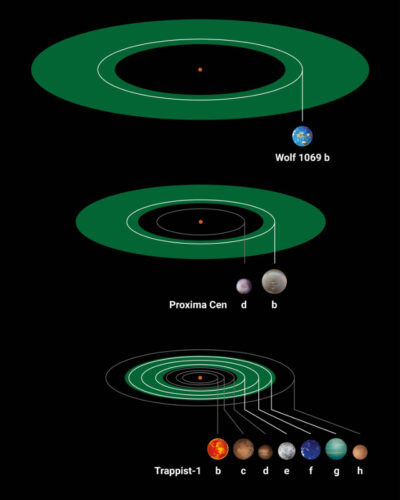
A comparison between the systems of Wolf 1069, Proxima Centauri, and TRAPPIST-1

An article published in the journal “Astronomy & Astrophysics” reports the identification of the exoplanet Wolf 1069 b, which has a mass close to the Earth’s and orbits within its star system’s habitable zone. A team of researchers led by Diana Kossakowski of the Max Planck Institute for Astronomy used the CARMENES spectrographs mounted on the 3.5-metre telescope of the Calar Alto Observatory, Spain, to identify traces of Wolf 1069 b using the radial velocity method. This exoplanet is tidally locked with its star, which poses a problem for habitability, but its star doesn’t have powerful flares. These characteristics make Wolf 1069 b an interesting object of study.

The new scheme of the orbits of the planets of the TOI 700 system

An article accepted for publication in “The Astrophysical Journal Letters” reports the discovery of the exoplanet TOI 700 e. A team of researchers used observations conducted with NASA’s TESS space telescope and confirmed with other instruments to find it. It’s the fourth planet discovered in the TOI 700 red dwarf system and is interesting because it’s a rocky planet a bit smaller than Earth. Its habitability potential is yet to be assessed because it’s within the so-called optimistic habitable zone, where a planet can only have liquid water on its surface for part of its history.

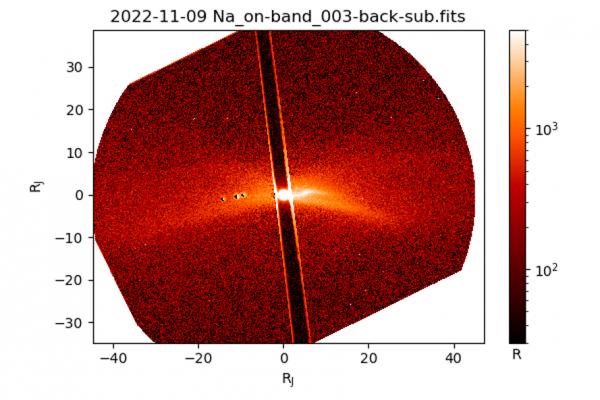
An image captured by the IoIO instrument on November 9, 2022, showing the sodium nebula emissions from the outburst originating from Io

A violent volcanic outburst was detected on Jupiter’s moon Io by Jeff Morgenthaler using the Io Input/Output observatory (IoIO) at the Planetary Science Institute (PSI). The scientist of this non-profit organization based in Arizona has been monitoring Io since 2017, observing several outbursts but the one in autumn 2022 was the most violent. This monitoring can also be useful for the mission of NASA’s Juno space probe, in orbit around Jupiter, as NASA is planning a Io flyby in December 2023 in which its instruments will be able to carry out measurements of the emitted gases such as sodium and ionized sulfur.

Sand dunes covered by frost on Mars (Image NASA/JPL-Caltech/University of Arizona)

To celebrate the winter solstice on Earth and the start of winter in the northern hemisphere, NASA has released some photos captured on Mars by its Mars Reconnaissance Orbiter space probe’s HiRISE camera showing what some Martian areas look like when it’s winter on the red planet. Seeing snowfall is still beyond the possibilities of the available instruments but frozen or at least frost-covered landscapes show some of the marvels of Mars.

An article published in “The Astrophysical Journal Letters” reports a study on the exoplanet Kepler-1658b which predicts the decay of its orbit until it’s destroyed by its star. A team of researchers used data gathered from observations conducted over several years, from those by the Kepler Space Telescope that discovered Kepler-1658b to those by the TESS Space Telescope to examine its orbit. The conclusion is that this gas giant is slowly approaching its star and will be destroyed in the future.