Planets

Image that celebrates the discovery of the exoplanet BEBOP-1 c (Image courtesy Amanda Smith / University of Birmingham)

An article published in the journal “Nature Astronomy” reports the discovery of a second circumbinary planet that orbits the two stars that form the BEBOP-1 system. A team of researchers used the HARPS and ESPRESSO spectrographs to find for the first time a circumbinary planet using the radial velocity method. This exoplanet, cataloged as BEBOP-1 c, joins TOI-1338 b, discovered in 2020 thanks to NASA’s TESS space telescope. Estimates indicate that BEBOP-1 c is a gas giant with a mass around 65 times the Earth’s and a year lasting about 215 Earth days.

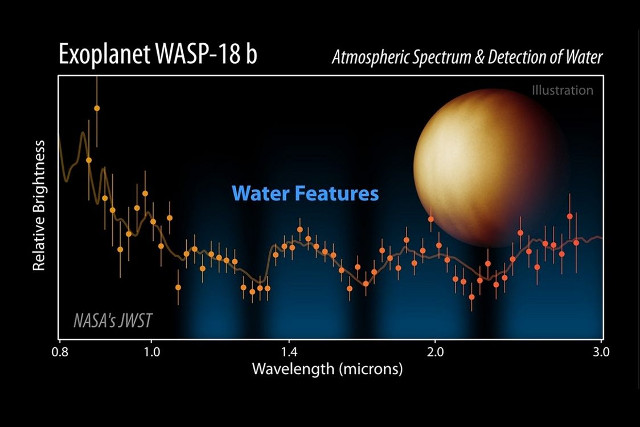
An artist's impression of the exoplanet WASP-18b and the spectrum of thermal emissions detected by the James Webb Space Telescope's NIRISS instrument at wavelengths between 0.85 and 2.8 microns

An article published in the journal “Nature” reports the results of an examination of the exoplanet WASP-18b. A team of researchers used the James Webb Space Telescope to map the temperatures on the surface of this ultra-hot Jupiter very close to its star. The temperature variations are around 1,000° Kelvin between the hottest area always facing its star and the border area between day and night. Webb’s Near-Infrared Imager and Slitless Spectrograph (NIRISS) also found traces of water vapor that other instruments had missed.

The infrared variations seen by a ground-based telescope in Jupiter's North Equatorial Belt between May 2001 and December 2011.

An article published in the journal “Nature Astronomy” reports a solution to the mystery of the change in color of some belts of the planet Jupiter’s atmosphere. A team of researchers used data collected by NASA’s Juno space probe to link those changes to the planet’s magnetic field. Scientists already knew the connection with variations in the infrared band, which means the propagation of electromagnetic field energy, about 50 kilometers below Jupiter’s surface. This new study brings evidence that the variations may in turn be caused by waves produced by the planetary magnetic field at depth.

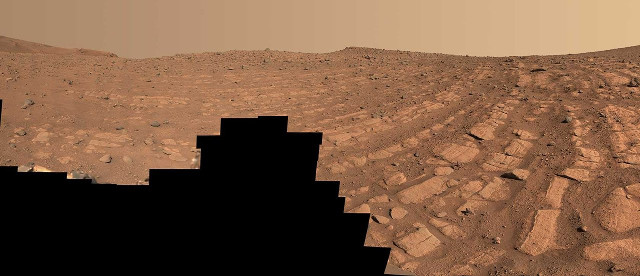
Skrinkle Haven on Mars (Image NASA/JPL-Caltech/ASU/MSSS)

Images captured by the Mars Rover Perseverance in an area nicknamed Skrinkle Haven in Jezero Crater on Mars indicate the presence of a river that flowed into that crater in ancient times. The surprise is that the layers of sediments and pebbles that form what was called a curvilinear unit suggest that that river was deeper and more powerful than all other ancient Martian rivers identified so far. A hill nicknamed Pinestand about 450 meters from Skrinkle Haven may have been formed by a powerful river but scientists are assessing other explanations as well.

On the right side, the disk in 2021 is shown with the already known shadow, here marked as (B), and the new shadow (C) generated by an inner disk.

An article published in “The Astrophysical Journal” reports the results of observations of the protoplanetary disk surrounding the very young star TW Hydrae. A team of researchers used observations conducted with the Hubble Space Telescope to examine the ongoing processes and evolution of planetary formation in the system. A protoplanet was identified in 2016 and that had increased the interest in that protoplanetary disk. In 2017, a shadow was identified that indicated the presence of an internal disk inclined relative to the external disk. Now a second shadow appears to come from another disk on the system’s inner side. This means that there may also be another planet in the making.