Planets

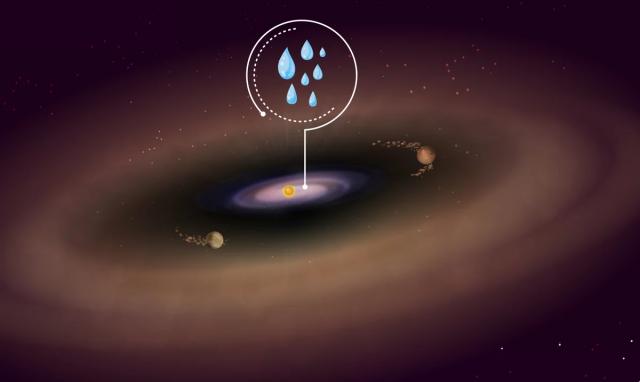
Artist's concept of the PDS 70 system: the star is surrounded by a protoplanetary disk in which two gas giant planets are forming. In the inner area, the zone where water was detected is indicated.

An article published in the journal “Nature” reports the discovery of water in the very young PDS 70 system. A team of researchers from the MINDS collaboration led by Giulia Perotti of the Max Planck Institute for Astronomy (MPIA) in Heidelberg, Germany, used the James Webb Space Telescope to detect the presence of water in the inner region of the protoplanetary disk surrounding the star PDS 70. Two planets were already identified in that disk and the detection of a debris cloud in a possible Trojan configuration was recently announced but there may also be rocky planets in formation on which water could play an important role in terms of habitability potential.

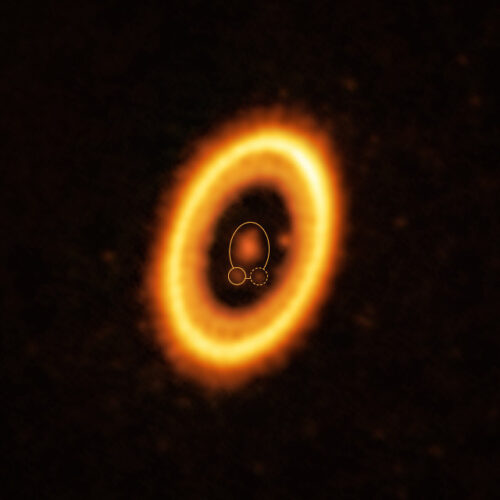
The PDS 70 system with its large protoplanetary disk. The larger circle indicates the orbit of the exoplanet PDS 70b, highlighted by another solid circle. A circle with a dashed line indicates the debris cloud that appears to occupy the same orbit.

An article published in the journal “Astronomy & Astrophysics” reports the discovery of a debris cloud that appears to share the orbit with the exoplanet PDS 70b. A team of astronomers reanalyzed observations conducted with the ALMA radio telescope to study the system of the very young star PDS 70 and its planets in their formation phase. The debris detected in the vicinity of PDS 70b could constitute another planet still in formation or be the remnants of a planet that had already formed.

Artist's concept of the exoplanet LTT 9779 b and its star (Image courtesy Ricardo Ramírez Reyes (Universidad de Chile)

An article published in the journal “Astronomy & Astrophysics” reports a study on the exoplanet LTT 9779 b, an ultrahot Neptune that was defined as the largest mirror in the universe because it reflects about 80% of the light it receives from its star. A team of researchers used observations conducted with ESA’s CHEOPS space telescope to study LTT 9779 b. They were able to calculate what is technically called albedo, the amount of light it reflects, in this case at exceptional levels. The conclusion is that such an extreme albedo is due to reflective metal clouds.

The movement of exoplanet AF Lep b, identified in the white spot near the arrows, in images captured in December 2021 and February 2023

An article published in “Astrophysical Journal Letters” reports the role of the astrometric technique in the discovery of one of the least massive planets so far photographed directly. A team of researchers used the Keck II telescope at the Keck Observatory in Hawaii to photograph the exoplanet cataloged AF Lep b, among the first discovered using the technique of astrometry, which is usually used in conjunction with other astronomical investigation methods. This offers new perspectives in the search for exoplanets.

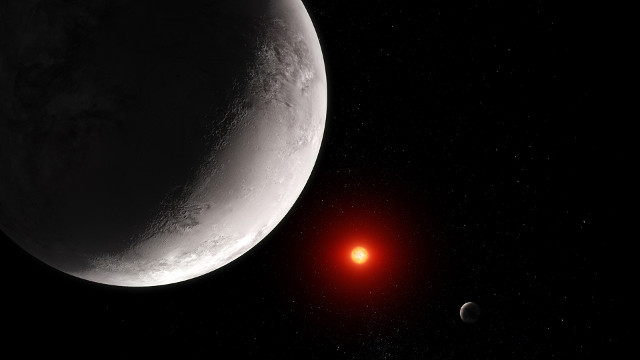
Artist's concept of the exoplanet TRAPPIST-1 c with its star in the background (Image NASA, ESA, CSA, Joseph Olmsted (STScI). Science: Sebastian Zieba (MPI-A), Laura Kreidberg (MPI-A))

An article published in the journal “Nature” reports a study on the exoplanet TRAPPIST-1 c which indicates that its atmosphere is very thin or non-existent. A team of researchers used the James Webb space telescope to examine one of the seven planets of the TRAPPIST-1 system and the results allow to rule out the hypothesis that it’s similar to Venus. Thermal emissions indicate a temperature on its surface’s day-side of about 107° Celsius. According to the researchers, this indicates that this exoplanet may have formed with little water.