Planets

Artist's concept of the TOI-4600 system (Image courtesy Tedi Vick)

An article published in the “Astrophysical Journal Letters” reports the discovery of two exoplanets orbiting the star TOI-4600 of which the outermost is the one with the longest year discovered so far. A team of researchers used observations conducted with NASA’s TESS space telescope to find traces of these two gas exoplanets. Other ground-based observatories were used to confirm the existence of these two exoplanets and obtain more information about them. TOI-4600 b has a year of nearly 83 Earth days, a bit shorter than Mercury’s, while TOI-4600 c has a year of nearly 483 days, the longest of all known exoplanets. This is a useful discovery to understand what other planetary systems are like because exoplanets close to their stars are much easier to discover while we still know very little about the ones far from their stars.

Artist's concept of the HD 45166 system with the helium star in the foreground (Image ESO/L. Calçada)

An article published in the journal “Science” reports a study that identifies one of the stars in the binary system HD 45166 as the likely precursor of a magnetar. A team of researchers led by Tomer Shenar of the University of Amsterdam used various telescopes to study a so-called helium star, a massive star that is nearing the end of its life and has already ejected its outer layers and is left with a core formed by helium on its surface. This star revealed an extremely powerful magnetic field, estimated to be about 100,000 times the Earth’s.

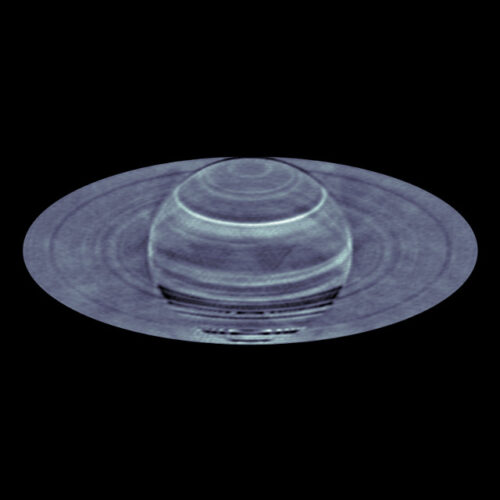
Saturn seen on radio waves from the VLA (Image S. Dvello (NRAO/AUI/NSF), I. de Pater et al (Berkeley))

An article published in the journal “Science Advances” reports a study on the megastorms active on the planet Saturn. A team of researchers used observations conducted with the VLA (Very Large Array) that allowed them to map the radio emissions coming from under Saturn’s surface and find anomalies in the distribution of ammonia gas. The conclusions of the study are that megastorms can last even a century and leave consequences that persist in the atmosphere even longer. This also shows differences from the giant storms existing on Jupiter.

One of the craters in the area called Jau

NASA celebrated the 11th anniversary of its Mars Rover Curiosity’s arrival on Mars with relief, as in recent days, the oldest rover still in operation on the red planet has just completed its most difficult ascent due to the terrain conditions. Curiosity reached an area filled with impact craters called Jau by climbing a 23° slope where there were obstacles such as slippery sand and rocks that could damage its wheels. The mission team managing route planning spent intense weeks deciding on several detours to limit danger and wear.

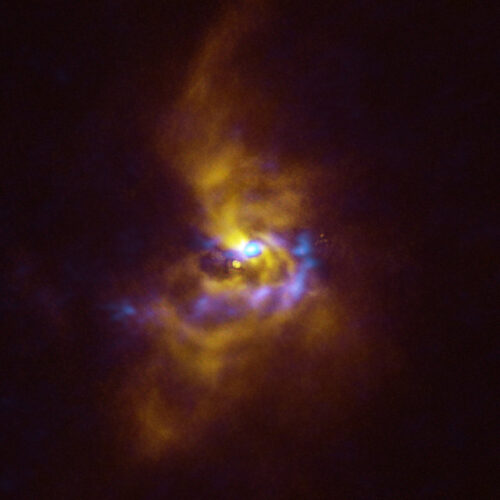
The V960 Mon system seen from SPHERE (yellow tones) and ALMA (blue tones) (Image ESO/ALMA (ESO/NAOJ/NRAO)/Weber et al.)

An article published in “The Astrophysical Journal Letters” reports the discovery of clumps of matter that could become planets around the young star V960 Mon. A team of researchers used the SPHERE instrument mounted on ESO’s VLT and the ALMA radio telescope, both in Chile, to examine the state of what could be a system in formation. The detection of masses estimated to be several times the Earth’s could constitute the first evidence of the formation of planets through the process of gravitational instability.