
Planets

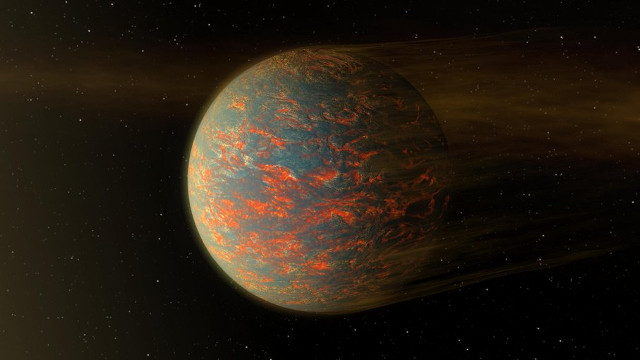
Artistic concept of a lava world (Image NASA/JPL-Caltech)

An article published in “The Astrophysical Journal” reports a study on so-called lava worlds, rocky exoplanets so close to their stars that at least a part of their surface is made up of molten rock. A team of researchers coordinated by the Ohio State University conducted computer simulations with the free / open source software ExoPlex to try to understand the evolution of these truly exotic planets, concluding that in certain cases, it’s possible that significant quantities of chemicals necessary for life remain trapped in their mantle. It remains unlikely, to say the least, that life forms could develop in those conditions, but if a planet of that type were to cool, the situation would change considerably. In any case, it’s important to understand its evolution because there may be many lava worlds that offer the possibility of studying a molten planetary mantle.

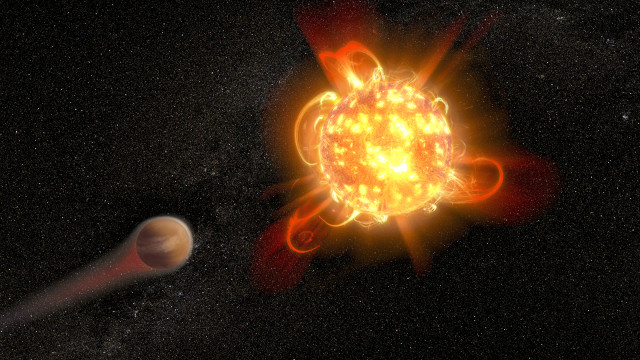
Artistic concept of a red dwarf in a phase of flares that strip the atmosphere from one of its planets (Image NASA, ESA, and D. Player (STScI))

An article accepted for publication in “The Astrophysical Journal” reports the results of spectroscopic observations of the activity of the star TRAPPIST-1 conducted with the James Webb Space Telescope. A team of researchers observed four flares of this ultra-cool dwarf, which occurred over the course of about 27 hours. By adding data obtained with other instruments, it was possible to develop a mathematical method to separate the light of those flares from normal stellar radiation. In the study of a very small but also active star, this is very useful to improve the quality of observations of the seven rocky planets of the TRAPPIST-1 system.

Artist's illustration of the exoplanet Tahay / GJ 367 b (Image NASA)

An article published in “The Astrophysical Journal Letters” reports a study on the exoplanet GJ 367 b, or Gliese 367 b, formally known by the name Tahay, which concludes that its core is composed almost entirely of iron for a density that is almost twice the Earth’s. The researchers also announced the discovery of two more planets in the system of the star GJ 367, formally known as Añañuca, which may be super-Earths.

Just over 30 light-years from Earth, Añañuca is a red dwarf with a mass and size just under half of the Sun’s. Observations began in 2019 with NASA’s TESS space telescope and in 2021 the data collected led to the exploration of the possibility that a planet orbited very close to this star, subsequently confirmed with other instruments. Tahay’s roughly 7.7-hour year is the shortest in the cosmic neighborhood, one reason for interest and worthy of its own name.

The HIP 81208 system seen by SPHERE

An article published in the journal “Astronomy & Astrophysics” reports the discovery of an object that could be a gas giant planet or a brown dwarf in the HIP 81208 system. A team of researchers analyzed data from the archive of the observations conducted with the SPHERE instrument mounted on the VLT in Chile discovering an object that was cataloged as HIP 81208 Cb orbiting the smaller of the two stars in this binary system. A brown dwarf was discovered around the more massive star together with the smaller and more distant star in an analysis also published some time ago in an article in “Astronomy & Astrophysics”. The new discovery makes HIP 81208 a so-called hierarchical quadruple system, the first of its kind discovered using a direct imaging system.

Artist's concept of the exoplanet K2-18 b with its star in the background (Image NASA, CSA, ESA, J. Olmstead (STScI), N. Madhusudhan (Cambridge University))

An article accepted for publication in the journal “The Astrophysical Journal Letters” reports the results of a study of the exoplanet K2-18 b, including the discovery of carbon compounds such as methane in its atmosphere. A team of researchers led by Nikku Madhusudhan of the British University of Cambridge used observations conducted with the James Webb Space Telescope’s NIRISS and NIRSpec instruments to probe the atmosphere of K2-18 b. It’s an exoplanet already considered interesting due to its characteristics and its position in its planetary system’s habitable zone. Spectral analyzes also suggest the possible presence of dimethyl sulfide (DMS), a compound considered a biomarker. These are discoveries that add to the previous ones regarding an exoplanet that led to the proposal of the Hycean class.