Planets

Illustration of the HD 63433 star system

An article published in “The Astronomical Journal” reports confirmation of the existence of the exoplanet HD 63433d, a rocky planet with a size close to the Earth’s that orbits a star very similar to the Sun in a system that was already known. A team of researchers led by Melinda Soares-Furtado of the University of Wisconsin-Madison and Benjamin Capistrant, now a student at the University of Florida, used data collected by NASA’s TESS space telescope to identify HD 63433d within the THYME (TESS Hunt for Young and Maturing Exoplanets) survey. Its close proximity to its star probably makes it a so-called lava planet since on the dayside, the temperature on its surface is estimated at over 1,500° Kelvin.

Artist's concept of potentially habitable exoplanets (Image courtesy Christine Daniloff, MIT; iStock)

An article published in the journal “Nature Astronomy” reports a study that examines the possibility of using the measurement of carbon scarcity in the atmosphere of a temperate rocky planet as an indicator of the presence of oceans of liquid water and possible life forms. A team of researchers led by Julien de Wit of MIT and Amaury Triaud of the British University of Birmingham devised a strategy based on the James Webb Space Telescope’s detection capabilities and includes an additional step consisting of the detection of ozone.

Artist's concept of the Kepler-385 star system (Image NASA/Daniel Rutter)

An article to be published in “The Journal of Planetary Science” reports updates to the catalog of exoplanet candidates discovered with NASA’s Kepler space telescope which offers confirmation of the presence of seven planets in the Kepler-385 star system. This result was obtained by applying examination methods that were significantly improved compared to the past, obtaining new results from old observations. That includes this system among the very few with over six verified or at least candidate planets, making it particularly interesting. However, all of these planets are closer to their star than the inner edge of that system’s habitable zone and receive a significant amount of energy from it. The consequence is that none of them can be similar to Earth.

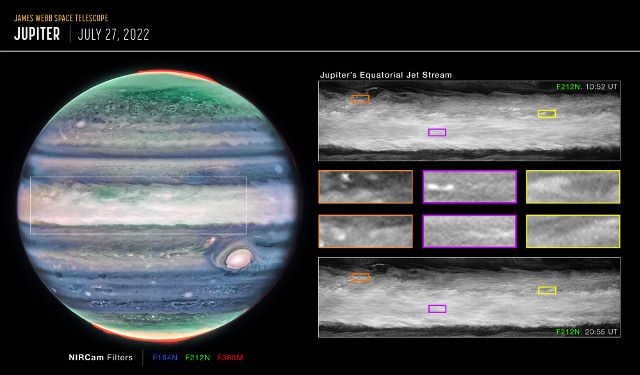
Jupiter in an observation with the NIRCam instrument and in the insets some progressive zooms showing various wind shears at altitudes between 20 and 35 kilometers above in Jupiter's clouds

An article published in the journal “Nature Astronomy” reports the discovery of an equatorial jet stream traveling at over 500 kilometers per hour in the lower layers of the stratosphere of the planet Jupiter extending for almost 5,000 kilometers. A team of researchers analyzed data collected by the James Webb Space Telescope’s NIRCam (Near-Infrared Camera) instrument during observations conducted in July 2022 to obtain details of the winds that include so-called wind shears, sudden variations in intensity and direction with altitude or distance. Data collected with the Hubble Space Telescope provided additional information about the atmosphere of Jupiter’s equator and other phenomena in that area useful in determining the characteristics of the jet stream.

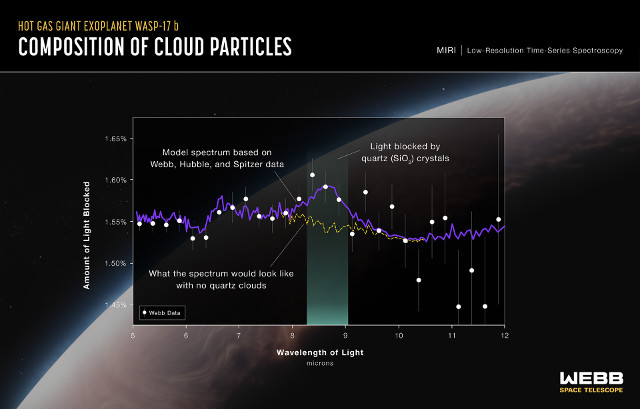
Transmission spectroscopy of the exoplanet WASP-17 b

An article published in “The Astrophysical Journal Letters” reports a study of the exoplanet WASP-17 b that includes the detection of quartz in this hot Jupiter’s atmosphere. A team of researchers used the James Webb Space Telescope to detect the subtle effects of quartz crystals, nanoparticles dispersed in the very hot atmosphere of WASP-17 b, which received the official name Ditsö̀ in early 2020.