Planets

An artist's impression of the GJ 1002 system with its two planets

An article published in the journal “Astronomy & Astrophysics” reports the discovery of two exoplanets that are slightly larger than Earth in the GJ 1002 star system, almost 16 light-years away from Earth. A team of researchers used a combination of data collected by two spectrographs, ESPRESSO mounted on the VLT and CARMENES at the Calar Alto observatory, to study GJ 1002 and find the traces of two exoplanets around it. Both of them are within their system’s habitable zone where there could be conditions similar to those on Earth. The top image (Courtesy Alejandro Suárez Mascareño and Inés Bonet (IAC)) shows an artist’s impression of the GJ 1002 system with its two planets.

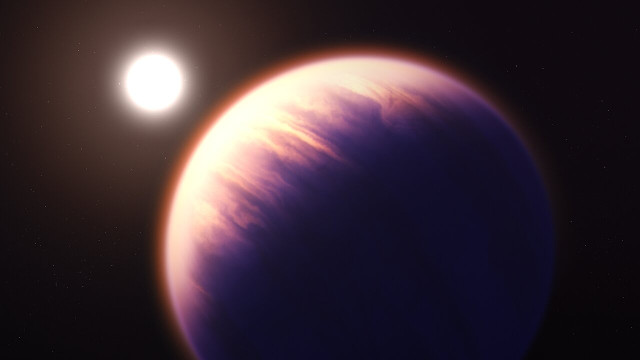
Artist's concept of the exoplanet WASP-39b and its star (Image NASA, ESA, CSA, J. Olmsted (STScI))

Five articles, three of which were accepted for publication in the journal “Nature” and two still under peer review, report various aspects of a study on the exoplanet WASP-39b. Many researchers participated in various ways in examining observations conducted with the James Webb Space Telescope focused in particular on the atmosphere of this very hot planet. Webb’s various instruments made it possible to detect a number of substances in WASP-39b’s atmosphere such as carbon monoxide, sodium, and potassium. For the first time, sulfur dioxide was detected in the atmosphere of an exoplanet and indicate that photochemical reactions are taking place.

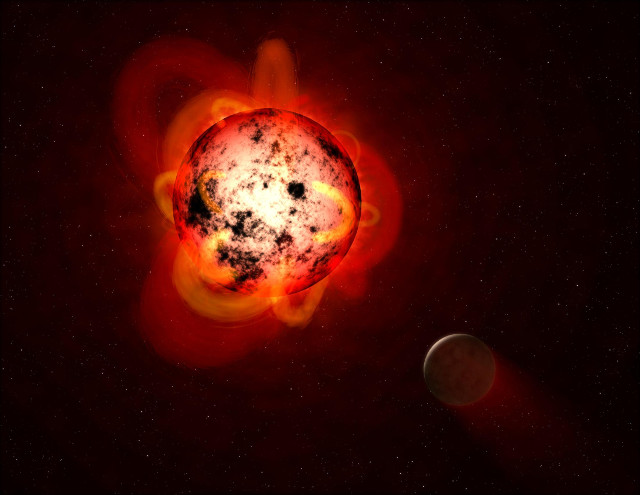
Artist's concept of a rocky planet's atmosphere being stripped by a red dwarf's flares

An article published in “The Astrophysical Journal Letters” reports a study on the exoplanet GJ 1252b which concludes that it has no atmosphere. In particular, a team of researchers used data collected by the Spitzer Space Telescope to examine this rocky planet which is about 20% larger than the Earth with a mass that is about 32% larger than the Earth’s. GJ 1252b orbits a red dwarf and according to the researchers, this star stripped this super-Earth’s atmosphere. This is due to the fact that red dwarfs are small but very active stars and confirms that it may be difficult to find a habitable planet around this type of star.

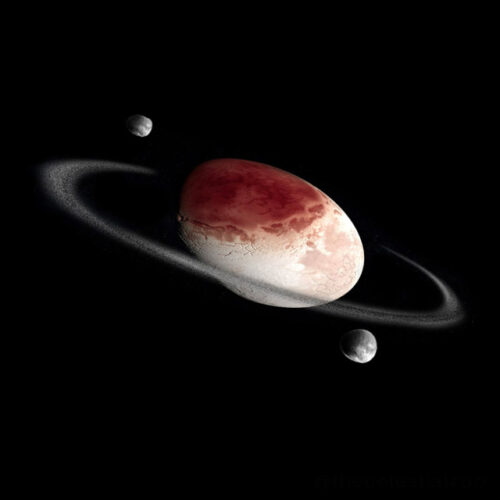
An artistic representation of Haumea with its moons Hiʻiaka and Namaka, which are actually much farther away from it, and its ring

An article published in the “Planetary Science Journal” reports the results of simulations that reproduce the possible history of the dwarf planet Haumea that led to its peculiar oval shape. A team of researchers used the geophysical and geochemical data available on Haumea and the asteroids that form a family with this dwarf planet to understand what processes led to their formation and evolution. The simulations lead to a reconstruction of the process that resulted in Haumea’s remarkable fast spin, which in turn led to its present shape.

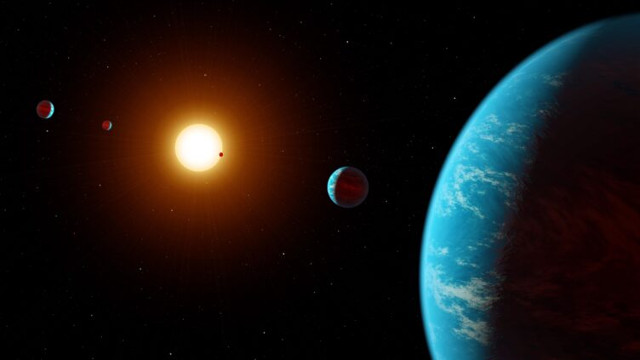
Artist's concept of a 5-Exoplanet system (Image NASA/JPL-Caltech))

An article published in the journal “Astronomy & Astrophysics” reports the confirmation of the presence of 5 rocky planets in the HD 23472 star system. A team of researchers used the Espresso spectrograph on ESO’s VLT to examine these exoplanets to estimate their masses using the radial velocity method. Their sizes were already known thanks to the data collected by NASA’s TESS space telescope, which observed their transit in front of their star. The result of the examination is that three of those exoplanets are super-Earths and two are probably super-Mercuries, rare cases characterized by a larger iron core and in general a high percentage of iron.