Planets

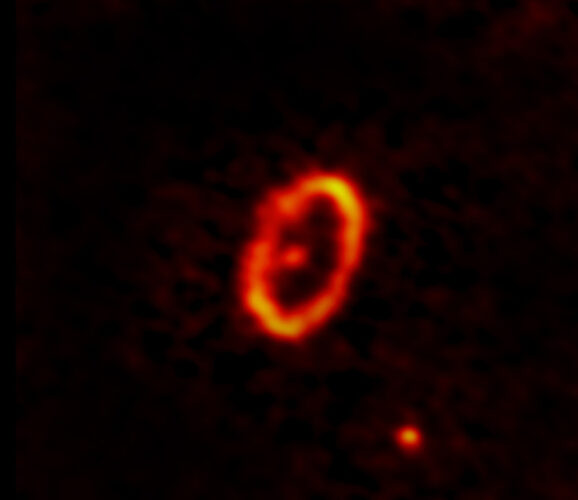
The HD 53143 system seen by ALMA (Image ALMA (ESO/NAOJ/NRAO)/M. MacGregor (U. Colorado Boulder); S. Dagnello (NRAO/AUI/NSF))

An article accepted for publication in “The Astrophysical Journal Letters” reports the results of a study of the young system of HD 53143, in which a Sun-like star is surrounded by a disk of materials with a structure different from all those known so far which could include a planet. A team of researchers used the ALMA radio telescope to study that disk, which is very eccentric instead of being circular with the star in its center. The disk around HD 53143 has an elliptical shape and the star is in one of the foci of the ellipse, far from the center. The results were presented at the 240th meeting of the American Astronomical Society (AAS) held these days in Pasadena, California.

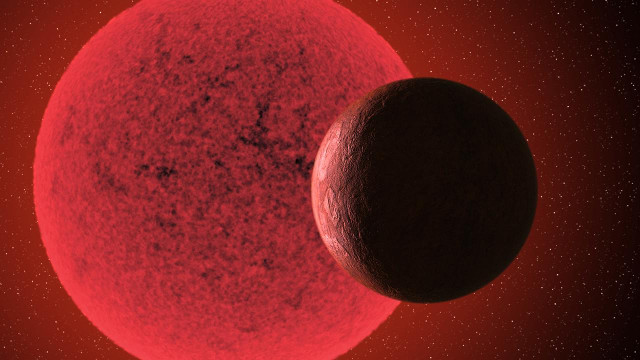
Artist's concept of a super-Earth orbiting close to a red dwarf (Image courtesy Gabriel Pérez Díaz, SMM (IAC))

An article accepted for publication in the journal “Publications of the Astronomical Society of Japan” reports the discovery of the exoplanet Ross 508 b, probably a super-Earth at the edge of ​​its star system’s habitable zone. A team of researchers led by Hiroki Harakawa used the IRD (InfraRed Doppler) instrument mounted on the Subaru Telescope to examine the star Ross 508, a red dwarf that has a mass that is only 18% of the Sun’s. The radial velocity method allowed to identify what from the collected data looks like a rocky planet with a mass that is about 4 times the Earth’s. This discovery confirms the value of infrared spectroscopic examinations of red dwarfs.

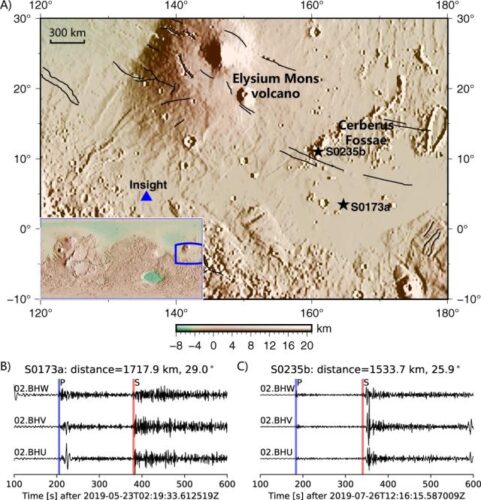
Map of the major marsquakes detected by the InSight lander

An article published in the journal “Nature Communications” reports a study that offers evidence that the marsquakes detected by NASA’s InSight lander are caused by the activity of underground volcanic magma. Doctor Weijia Sun of the Chinese Academy of Sciences and Professor Hrvoje Tkalčić of the Australian National University examined data collected by InSight identifying 47 underground marsquakes in the Cerberus Fossae region of Mars over the course of 350 Martian days. According to the two researchers, the Martian mantle is still active and the marsquakes are of volcanic origin and not tectonic, as the scientists who studied Mars believed.

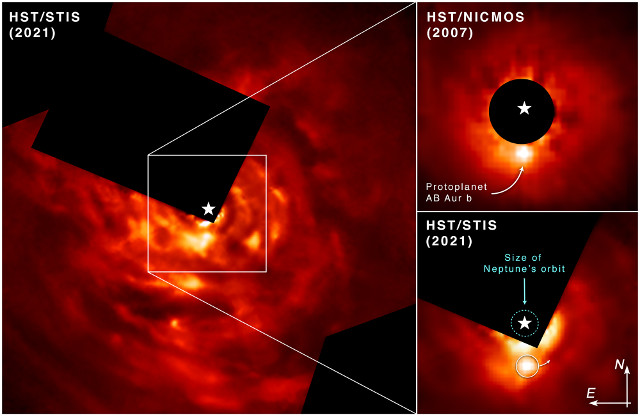
The AB Aurigae system and its protoplanet seen by Hubble

An article published in the journal “Nature Astronomy” reports a study on the protoplanet cataloged as AB Aurigae b, a gas giant that is growing following an unusual process called disk instability. A team of researchers used observations made with the Hubble Space Telescope and the Subaru Telescope on Mauna Kea, Hawaii, between 2007 and 2021 to find evidence of that violent formation. Proving that gas giants can form as a result of disk instability will help better understand the history of the solar system as well.

A portion of Pluto's surface in grayscale with an artistic interpretation of how cryovolcanic processes may have operated indicated in blue

An article published in the journal “Nature Communications” reports a study on the activity of cryovolcanoes existing on the dwarf planet Pluto which highlights how it has continued until recent times from a geological point of view and may still be present. A team of researchers led by Kelsi Singer of the Southwest Research Institute used data collected by NASA’s New Horizons space probe to examine the marks left by cryovolcanoes in the Sputnik Planitia region, in the large heart-shaped area on the surface. One conclusion is that Pluto has an underground heat source that kept it geologically active much longer than might be expected from a dwarf planet.