Planets

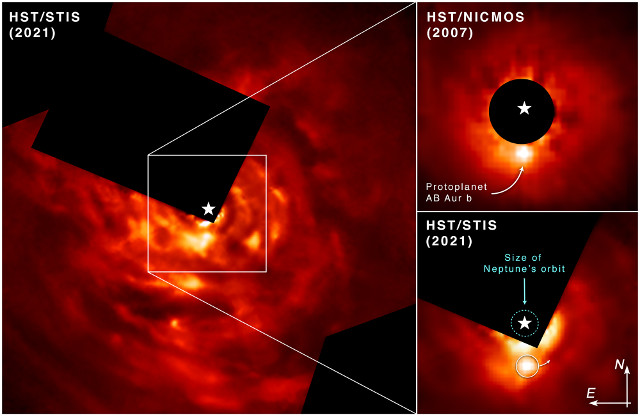
The AB Aurigae system and its protoplanet seen by Hubble

An article published in the journal “Nature Astronomy” reports a study on the protoplanet cataloged as AB Aurigae b, a gas giant that is growing following an unusual process called disk instability. A team of researchers used observations made with the Hubble Space Telescope and the Subaru Telescope on Mauna Kea, Hawaii, between 2007 and 2021 to find evidence of that violent formation. Proving that gas giants can form as a result of disk instability will help better understand the history of the solar system as well.

A portion of Pluto's surface in grayscale with an artistic interpretation of how cryovolcanic processes may have operated indicated in blue

An article published in the journal “Nature Communications” reports a study on the activity of cryovolcanoes existing on the dwarf planet Pluto which highlights how it has continued until recent times from a geological point of view and may still be present. A team of researchers led by Kelsi Singer of the Southwest Research Institute used data collected by NASA’s New Horizons space probe to examine the marks left by cryovolcanoes in the Sputnik Planitia region, in the large heart-shaped area on the surface. One conclusion is that Pluto has an underground heat source that kept it geologically active much longer than might be expected from a dwarf planet.

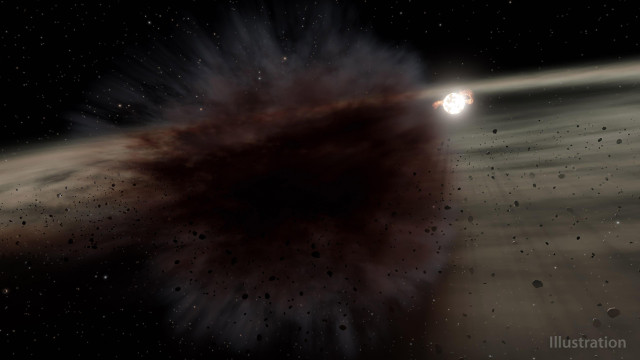
Artist's concept of a cloud of debris in the system of the star HD 166191 (Image NASA/JPL-Caltech)

An article published in “The Astrophysical Journal” reports a study on the star system cataloged as HD 166191, which has an estimated age of 10 million years and is still in its formation process with objects that form but also get destroyed following collisions. A team of researchers led by Kate Su of the University of Arizona used data collected between 2015 and 2019 using NASA’s Spitzer Space Telescope and ground-based telescopes to detect traces of debris clouds generated by collisions between planetesimals. The information obtained from these data is very useful to improve our knowledge of the formation and evolution of planetary systems.

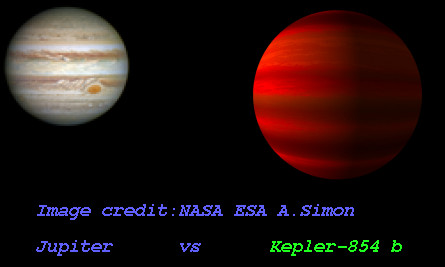
Artist's concept of Kepler-854b as en exoplanet compared to Jupiter

An article published in “The Astronomical Journal” reports a study that reviews the data of four objects discovered a few years ago thanks to NASA’s Kepler space telescope, concluding that at least three of them are actually tiny stars and not planets. A team of researchers used new data collected by ESA’s Gaia space probe to get more precise information on objects cataloged as exoplanets. Kepler-854b, Kepler-840b, and Kepler-699b appear to have sizes between two and four times Jupiter’s, too much even for hot Jupiters very close to their stars but possible for tiny stars. Kepler-747b turns out to have a radius 1.8 times Jupiter’s even though it’s quite far from a star a little smaller than the Sun, so its nature is uncertain.

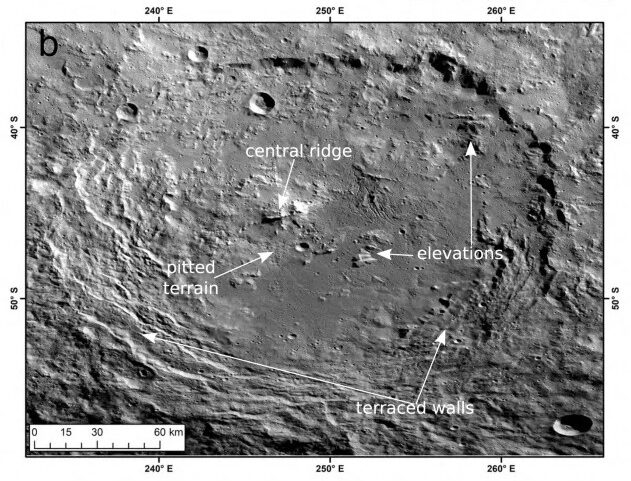
Urvara crater on the dwarf planet Ceres

An article published in the journal “Nature Communications” reports the identification of salts and organic compounds in Urvara crater on the dwarf planet Ceres. A team of researchers used data collected by NASA’s Dawn space probe to conduct the most detailed investigation of Urvara Crater, the third-largest impact crater on Ceres. The results are not surprising and indeed confirm the discoveries of recent years concerning above all the two largest craters, Occator and Ernutet. The famous bright spots that were named faculae in jargon, mysterious before close examinations, shine thanks to the salts they contain, and now the confirmation also arrived for Urvara. This result also confirms the presence at least in the past of an underground ocean in which very salty water remained in a liquid state and perhaps there’s still some.