Planets

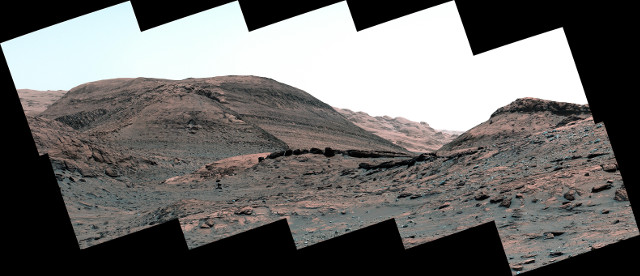
An area of Gale Crater (Image NASA/JPL-Caltech/MSSS)

NASA has released the results of data analysis recently collected by its Mars Rover Curiosity during its ascent of Mount Sharp on Mars. After spending years in areas of Gale Crater that surround the zone where there were still many traces of the ancient presence of water, Curiosity started traveling in a transition zone from a clay-rich region to one full of sulfate salt. The interest in that area is given by the fact that it shows the traces of the great climatic changes that transformed a planet that, when it was young, was similar to the Earth into today’s red planet.

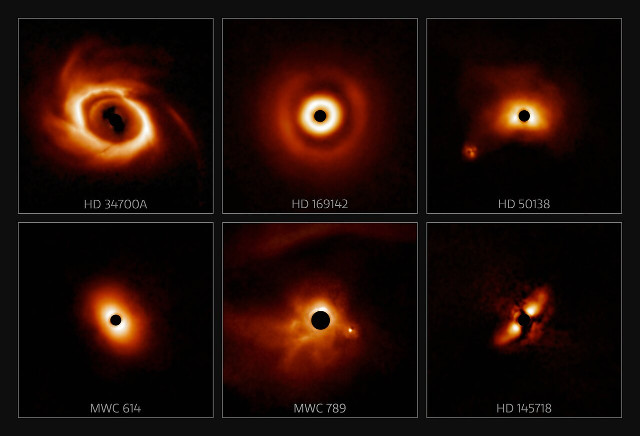
6 of the systems studied in the Gemini-LIGHTS survey

An article accepted for publication in “The Astronomical Journal” reports the results of the Gemini-LIGHTS survey on 44 young massive stars. A team of researchers used the Gemini Planet Imager (GPI) mounted on the Gemini South telescope in Chile to study the disks of materials around these stars to see if planets and ring structures have formed inside them. The results revealed the presence of possible planets and even brown dwarfs with differences between disks surrounding stars up to three times the mass of the Sun and disks surrounding more massive stars.

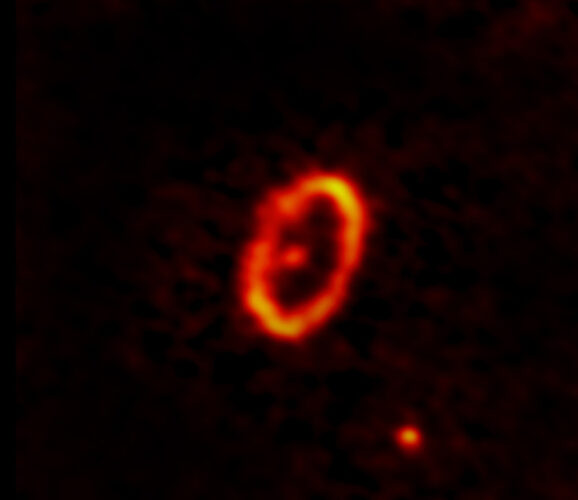
The HD 53143 system seen by ALMA (Image ALMA (ESO/NAOJ/NRAO)/M. MacGregor (U. Colorado Boulder); S. Dagnello (NRAO/AUI/NSF))

An article accepted for publication in “The Astrophysical Journal Letters” reports the results of a study of the young system of HD 53143, in which a Sun-like star is surrounded by a disk of materials with a structure different from all those known so far which could include a planet. A team of researchers used the ALMA radio telescope to study that disk, which is very eccentric instead of being circular with the star in its center. The disk around HD 53143 has an elliptical shape and the star is in one of the foci of the ellipse, far from the center. The results were presented at the 240th meeting of the American Astronomical Society (AAS) held these days in Pasadena, California.

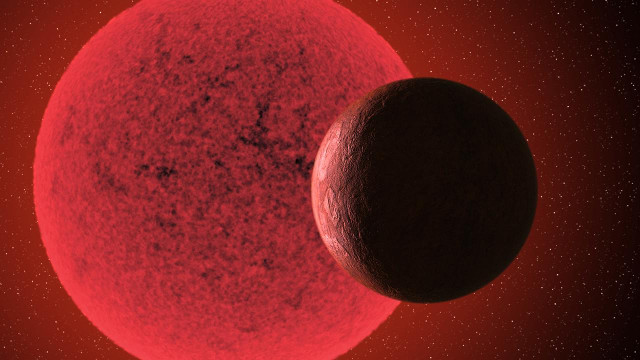
Artist's concept of a super-Earth orbiting close to a red dwarf (Image courtesy Gabriel Pérez Díaz, SMM (IAC))

An article accepted for publication in the journal “Publications of the Astronomical Society of Japan” reports the discovery of the exoplanet Ross 508 b, probably a super-Earth at the edge of ​​its star system’s habitable zone. A team of researchers led by Hiroki Harakawa used the IRD (InfraRed Doppler) instrument mounted on the Subaru Telescope to examine the star Ross 508, a red dwarf that has a mass that is only 18% of the Sun’s. The radial velocity method allowed to identify what from the collected data looks like a rocky planet with a mass that is about 4 times the Earth’s. This discovery confirms the value of infrared spectroscopic examinations of red dwarfs.

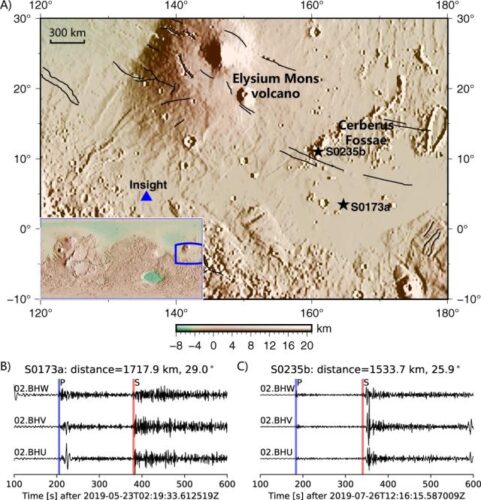
Map of the major marsquakes detected by the InSight lander

An article published in the journal “Nature Communications” reports a study that offers evidence that the marsquakes detected by NASA’s InSight lander are caused by the activity of underground volcanic magma. Doctor Weijia Sun of the Chinese Academy of Sciences and Professor Hrvoje Tkalčić of the Australian National University examined data collected by InSight identifying 47 underground marsquakes in the Cerberus Fossae region of Mars over the course of 350 Martian days. According to the two researchers, the Martian mantle is still active and the marsquakes are of volcanic origin and not tectonic, as the scientists who studied Mars believed.