Planets

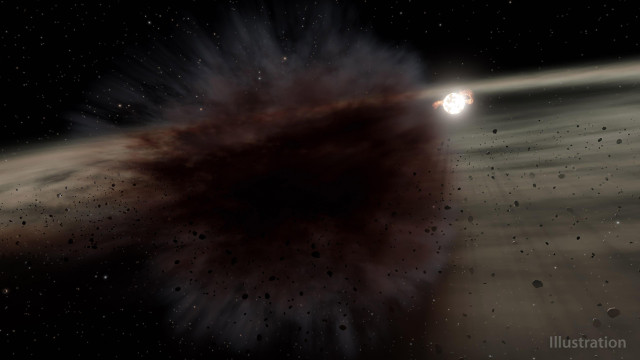
Artist's concept of a cloud of debris in the system of the star HD 166191 (Image NASA/JPL-Caltech)

An article published in “The Astrophysical Journal” reports a study on the star system cataloged as HD 166191, which has an estimated age of 10 million years and is still in its formation process with objects that form but also get destroyed following collisions. A team of researchers led by Kate Su of the University of Arizona used data collected between 2015 and 2019 using NASA’s Spitzer Space Telescope and ground-based telescopes to detect traces of debris clouds generated by collisions between planetesimals. The information obtained from these data is very useful to improve our knowledge of the formation and evolution of planetary systems.

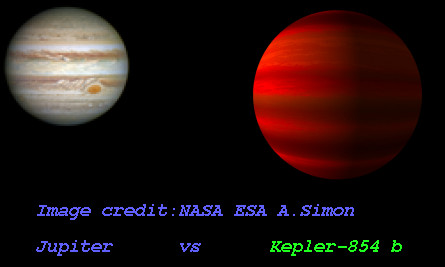
Artist's concept of Kepler-854b as en exoplanet compared to Jupiter

An article published in “The Astronomical Journal” reports a study that reviews the data of four objects discovered a few years ago thanks to NASA’s Kepler space telescope, concluding that at least three of them are actually tiny stars and not planets. A team of researchers used new data collected by ESA’s Gaia space probe to get more precise information on objects cataloged as exoplanets. Kepler-854b, Kepler-840b, and Kepler-699b appear to have sizes between two and four times Jupiter’s, too much even for hot Jupiters very close to their stars but possible for tiny stars. Kepler-747b turns out to have a radius 1.8 times Jupiter’s even though it’s quite far from a star a little smaller than the Sun, so its nature is uncertain.

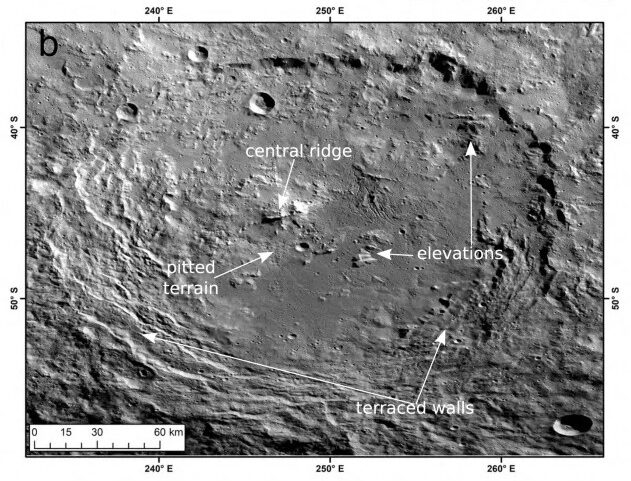
Urvara crater on the dwarf planet Ceres

An article published in the journal “Nature Communications” reports the identification of salts and organic compounds in Urvara crater on the dwarf planet Ceres. A team of researchers used data collected by NASA’s Dawn space probe to conduct the most detailed investigation of Urvara Crater, the third-largest impact crater on Ceres. The results are not surprising and indeed confirm the discoveries of recent years concerning above all the two largest craters, Occator and Ernutet. The famous bright spots that were named faculae in jargon, mysterious before close examinations, shine thanks to the salts they contain, and now the confirmation also arrived for Urvara. This result also confirms the presence at least in the past of an underground ocean in which very salty water remained in a liquid state and perhaps there’s still some.

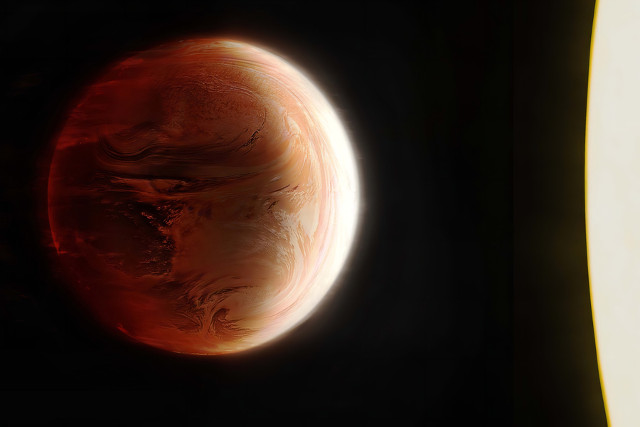
Artist's concept of the exoplanet WASP-121b (Image Engine House VFX)

An article published in the journal “Nature Astronomy” reports the results of a new study on the exoplanet WASP-121b, an ultrahot Jupiter considered one of the planets with the most extreme conditions known. A team of researchers led by Tom Evans, today at the Max Planck Institute for Astronomy in Heidelberg, Germany, used data collected by the Hubble Space Telescope to investigate compounds present in WASP-121b’s atmosphere. The conclusion is that there may be clouds of iron, titanium, and corundum, the crystallized form of aluminum oxide that makes up rubies and sapphires.

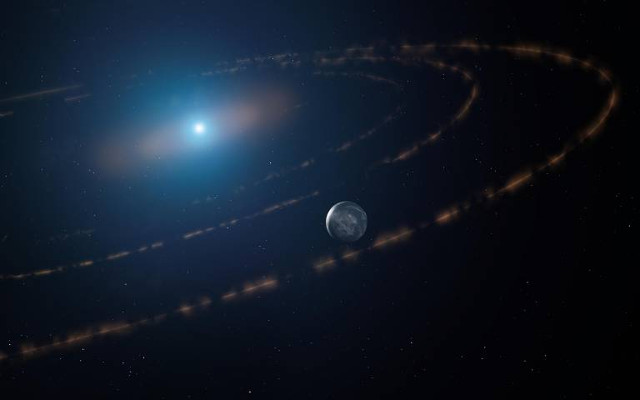
Artist's concept of WD1054-226's system (Image courtesy Mark A. Garlick / markgarlick.com)

An article published in the journal “Monthly Notice of the Royal Astronomical Society” reports the observation of debris orbiting the white dwarf cataloged as WD1054-226 in a formation that suggests a gravitational bond such as the one which can be generated by a planet. A team of researchers used the ULTRACAM camera mounted on ESO’s NTT telescope at La Silla Observatory in Chile to examine objects that regularly pass in front of those star remnants. Data obtained from NASA’s TESS space telescope helped identify what appears to be a disk of debris that hasn’t dispersed, perhaps thanks to a planet acting as a sort of shepherd that keeps them bound. The planet would be in ​​that system’s habitable area, a special case since it has a white dwarf at its center.