Planets

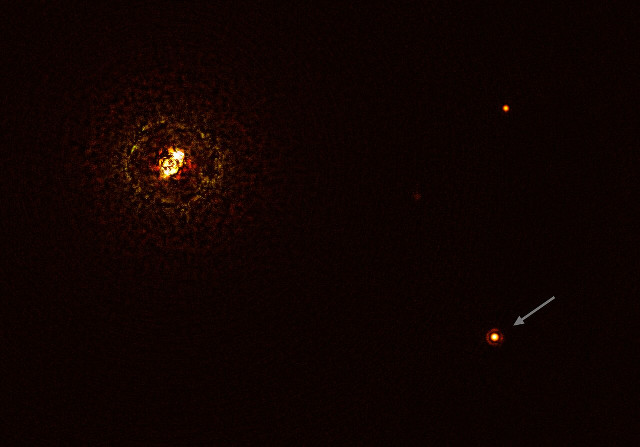
b Centauri's system seen by SPHERE

An article published in the journal “Nature” reports the discovery of a planet in the binary system b Centauri, the most massive in which a planet has been discovered. A team of researchers used ESO’s VLT in Chile to locate the exoplanet cataloged as b Centauri (AB)b or simply b Centauri b photographing it with the SPHERE instrument. It’s a record-breaking planet also because it has a mass estimated at about ten times Jupiter’s, making it one of the most massive known planets, with an orbit that is about one hundred times farther from the two stars than Jupiter’s distance from the Sun. The researchers think that b Centauri b likely formed in another area of its system and then moved due to gravitational interactions.

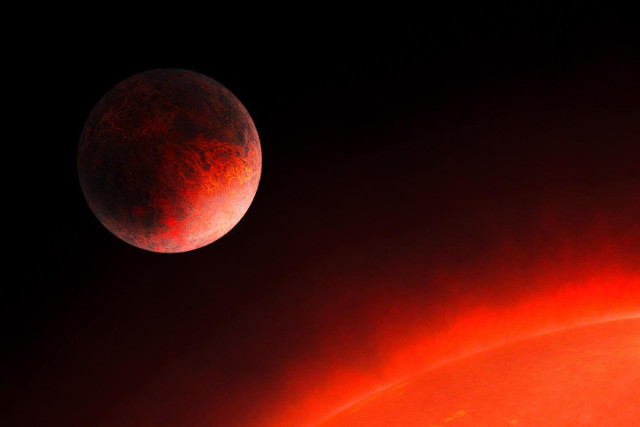
Artist impression of exoplanet GJ 367 b (Image courtesy SPP 1992 (Patricia Klein))

An article published in the journal “Science” reports the discovery of the exoplanet GJ 367 b, about the size of Mars, with a year lasting only eight hours. A team of researchers led by Kristine Lam and Szilárd Csizmadia of DLR, the German aerospace agency, used observations conducted by NASA’s TESS space telescope and follow-up detections conducted with the ESO’s 3.6-meter telescope in La Silla, Chile’s HARPS instrument to obtain information on GJ 367 b. You could say that it’s a super-Mercury since the two planets have a similar iron core but on the side of GJ 367 b facing its star, a red dwarf, the estimated temperature is about 1,500° Celsius.

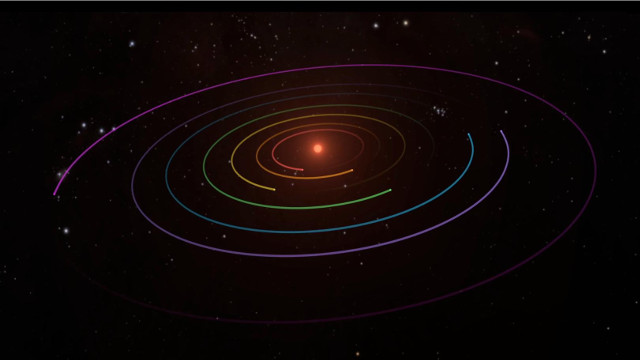
Scheme of TRAPPIST-1 planets' orbits (Image NASA/JPL-Caltech)

An article published in the journal “Nature Astronomy” reports a study on the formation of the planets of the ultra-cool star TRAPPIST-1’s system. A team of researchers exploited the particular configuration of the seven rocky planets to calculate how long their formation may have taken, obtaining a maximum value of a few million years, only a tenth of the time it took for the Earth to form. That’s because the resonance that exists between the planets can only have been maintained in the absence of a late bombardment of the kind that occurred in the solar system that completed its planets’ formation. One consequence is that water must have been absorbed by TRAPPIST-1’s planets during their formation in the protoplanetary disk.

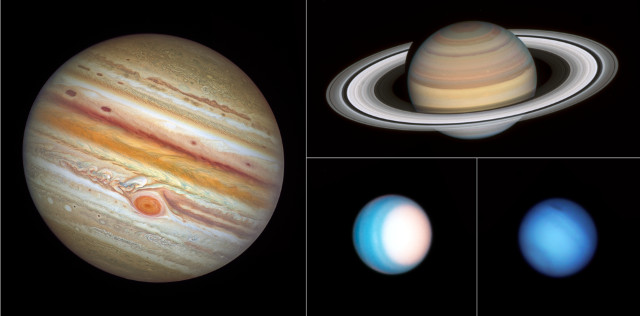
Jupiter, Saturn, Uranus, and Neptune seen by Hubble

A composition of images captured by the Hubble Space Telescope brings together the solar system’s giant planets on a grand tour of the outer planets. Jupiter, Saturn, Uranus, and Neptune are among the targets of periodic observations in programs such as OPAL (Outer Planets Atmospheres Legacy) to keep an eye on the changes that occur over time in their atmospheres. Along with other instruments, which in some cases include space probes, Hubble is an important contributor to studies of gas planets. Programs such as OPAL are also useful in developing models for studying gas exoplanets in other star systems.

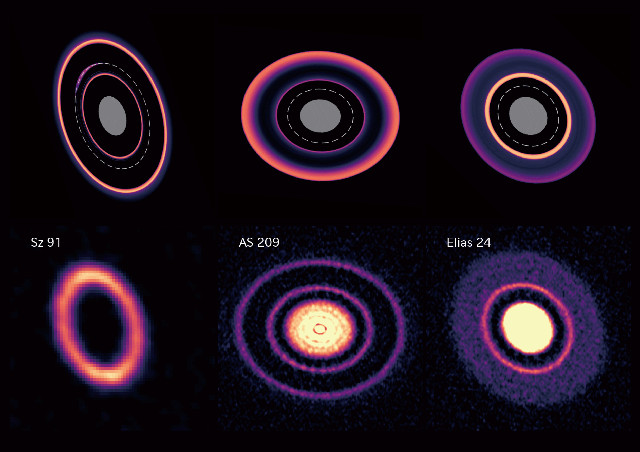
Simulations of protoplanetary disks indicate the movements of newborn planets

An article published in “The Astrophysical Journal” reports a study on protoplanetary disks that offers a solution to the rarity of the discovery of newborn exoplanets near the rings that form inside them. A team of three Japanese researchers used the ATERUI II supercomputer, the most powerful used in astronomy, to create simulations of planetary systems’ evolution. The results indicate that the planets create rings as they grow but subsequently move away from them.