Planets

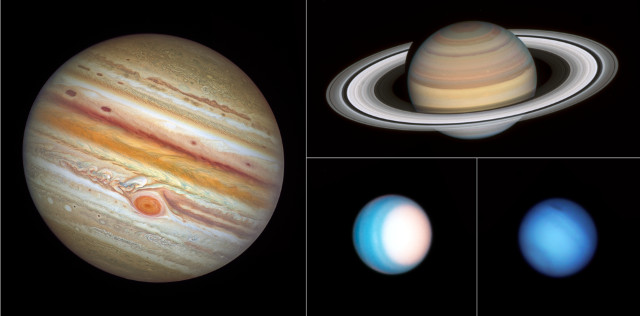
Jupiter, Saturn, Uranus, and Neptune seen by Hubble

A composition of images captured by the Hubble Space Telescope brings together the solar system’s giant planets on a grand tour of the outer planets. Jupiter, Saturn, Uranus, and Neptune are among the targets of periodic observations in programs such as OPAL (Outer Planets Atmospheres Legacy) to keep an eye on the changes that occur over time in their atmospheres. Along with other instruments, which in some cases include space probes, Hubble is an important contributor to studies of gas planets. Programs such as OPAL are also useful in developing models for studying gas exoplanets in other star systems.

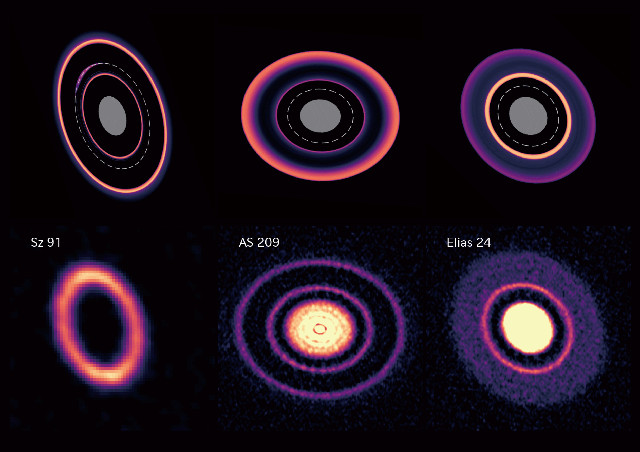
Simulations of protoplanetary disks indicate the movements of newborn planets

An article published in “The Astrophysical Journal” reports a study on protoplanetary disks that offers a solution to the rarity of the discovery of newborn exoplanets near the rings that form inside them. A team of three Japanese researchers used the ATERUI II supercomputer, the most powerful used in astronomy, to create simulations of planetary systems’ evolution. The results indicate that the planets create rings as they grow but subsequently move away from them.

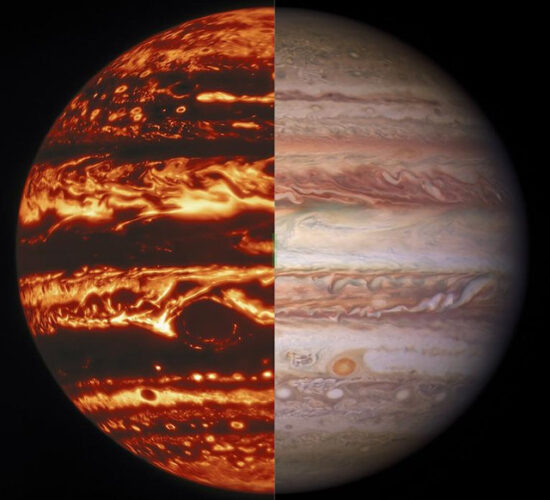
Jupiter seen at infrareds and visible light

Various articles published in the journals “Science”, “Journal of Geophysical Research: Planets”, and “Geophysical Research Letters” report various results of the research conducted on planet Jupiter’s atmosphere. Various teams of researchers used data gathered by NASA’s Juno space probe to obtain various results. For the first time, it’s been possible to create a 3D reconstruction of the Jovian atmosphere that offers a better understanding of how the bands that envelop the planet and are known as belts and zones work, of the polar cyclones, and the Great Red Spot.

M51 and an illustration of the system that could host an exoplanet

An article published in the journal “Nature Astronomy” reports the identification of a candidate exoplanet in another galaxy, cataloged as M51-ULS-1b. A team of researchers used NASA’s Chandra X-ray Observatory and ESA’s XMM-Newton Space Telescope to examine what could be the transit of a Saturn-sized exoplanet in M51, a pair of galaxies. In the larger of the two galaxies, there’s an ultra-luminous X-ray source consisting of a dead star and a blue supergiant, and the candidate exoplanet orbits them. The first confirmation of an extragalactic exoplanet would be extraordinary but in this case, not all alternative explanations can be completely ruled out.

The exoplanet 2M0437b near its star

An article published in the journal “Monthly Notices of the Royal Astronomical Society” reports the discovery of a newborn planet orbiting the red dwarf star 2M0437. A team coordinated by the University of Hawaii at Mānoa used various telescopes to confirm that the discovered object was a planet orbiting that star and to capture a direct image of it. 2M0437b is one of the youngest exoplanets discovered so far, born together with its star in the Taurus Cloud, a stellar nursery that has been the subject of various astronomical studies.