Planets

Artist's concept of red dwarf magnetically interacting with a planet (Image courtesy Danielle Futselaar (artsource.nl))

Two articles – one published in the journal “Nature Astronomy” and one published in “The Astrophysical Journal Letters” – report different aspects of the discovery of radio wave emissions from 19 red dwarfs of which at least 4 could have originated from interaction with unknown planets. This study is based on detections obtained with the LOFAR radio telescope to examine the stellar magnetic activity of 19 red dwarfs. Radio emissions have also been detected from ancient and magnetically inactive stars. Data collected by NASA’s TESS space telescope was also added to get a more complete picture of that activity. The most likely explanation is that there’s an interaction with the magnetic field of planets that haven’t been detected.

An article published in “The Astrophysical Journal Letters” reports a study on the exoplanet WASP-76b, an ultra-hot Jupiter where conditions could be even more hellish than previously thought. A team of researchers used the Gemini North telescope to study WASP-76b, the case that inaugurates a planetary atmosphere mapping project at Cornell University as part of ExoGemS (Exoplanets with Gemini Spectroscopy Survey). The discovery of abundant ionized calcium indicates that the temperature in the atmosphere is much higher than previous estimates or that there are very intense winds in the upper atmosphere.

GW Orionis' protoplanetary dsk

An article published in the journal “Monthly Notices of the Royal Astronomical Society” reports a study on the triple system of GW Orionis, or simply GW Ori, which claims that there is at least one exoplanet, which would be the first known to orbit three stars. A team of researchers led by Jeremy Smallwood of the University of Nevada Las Vegas examined observations of the rings of GW Ori’s protoplanetary disk made with the ALMA radio telescope. The goal was to try to establish the cause of the presence of void within one of them and the conclusion is that one or more exoplanets have formed or are forming.

Artistic illustration comparing the sizes of Earth, TOI-1634b, and TOI-1685b

An article published in “The Astronomical Journal” reports a study on two “bare” super-Earths, as they lack a primordial atmosphere. A team of researchers used the Subaru telescope and other instruments for a follow-up study of two candidate exoplanets discovered by NASA’s TESS space telescope and classified as TOI-1634b and TOI-1685b. Both candidates were confirmed and showed some characteristics in common since they’re super-Earths with orbits that are very close to their stars, both red dwarfs, with no primordial atmosphere. Their study will help to understand the evolution of the atmospheres of hot rocky planets.

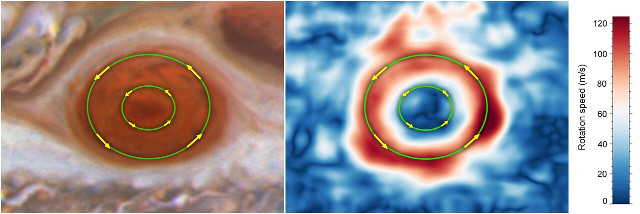
The Great Red Spot with green circles indicating the areas where changes in wind speeds have been detected

An article published in the journal “Geophysical Research Letters” reports a study on the changes that occurred in the winds present in the famous Great Red Spot on the planet Jupiter. A team of researchers analyzed observations conducted with the Hubble Space Telescope between 2009 and 2020 to conclude that the winds in the outer zone of the Great Red Spot are accelerating. On the contrary, the winds near the innermost region of the colossal Jovian storm are slowing down.