Planets

GW Orionis' protoplanetary dsk

An article published in the journal “Monthly Notices of the Royal Astronomical Society” reports a study on the triple system of GW Orionis, or simply GW Ori, which claims that there is at least one exoplanet, which would be the first known to orbit three stars. A team of researchers led by Jeremy Smallwood of the University of Nevada Las Vegas examined observations of the rings of GW Ori’s protoplanetary disk made with the ALMA radio telescope. The goal was to try to establish the cause of the presence of void within one of them and the conclusion is that one or more exoplanets have formed or are forming.

Artistic illustration comparing the sizes of Earth, TOI-1634b, and TOI-1685b

An article published in “The Astronomical Journal” reports a study on two “bare” super-Earths, as they lack a primordial atmosphere. A team of researchers used the Subaru telescope and other instruments for a follow-up study of two candidate exoplanets discovered by NASA’s TESS space telescope and classified as TOI-1634b and TOI-1685b. Both candidates were confirmed and showed some characteristics in common since they’re super-Earths with orbits that are very close to their stars, both red dwarfs, with no primordial atmosphere. Their study will help to understand the evolution of the atmospheres of hot rocky planets.

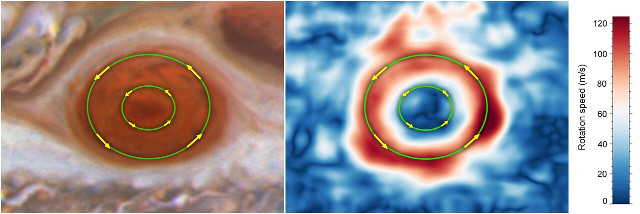
The Great Red Spot with green circles indicating the areas where changes in wind speeds have been detected

An article published in the journal “Geophysical Research Letters” reports a study on the changes that occurred in the winds present in the famous Great Red Spot on the planet Jupiter. A team of researchers analyzed observations conducted with the Hubble Space Telescope between 2009 and 2020 to conclude that the winds in the outer zone of the Great Red Spot are accelerating. On the contrary, the winds near the innermost region of the colossal Jovian storm are slowing down.

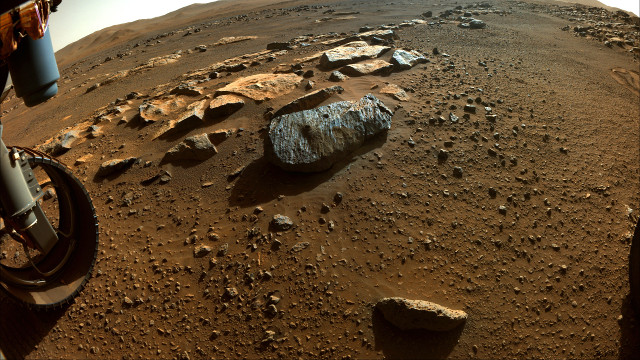
The Rochette rock (Image NASA/JPL-Caltech)

NASA has published the first results of the examination of the first two rock samples collected in recent days by the Mars Rover Perseverance in the Jezero crater on planet Mars. After last month’s disappointment, with the failure of the first attempt to take a sample of a rock that proved too crumbly, there were two successes. A rock nicknamed Rochette proved suitable and Perseverance was successful in taking a sample nicknamed Montdenier on September 6 and a sample nicknamed Montagnac on September 8. The most interesting indication is that there was water in the area for a long time when the environment was potentially habitable.

A representation of the solar system up to the Kuiper Belt

An article published in “The Planetary Science Journal” reports a study on some Kuiper Belt Objects (KBOs) that are part of a particular group of which new observations revealed a blue color and a binary nature. A team of researchers used observations ran by the Col-OSSOS team which obtained color measurements of 98 Kuiper Belt Objects while also offering new insights into the subgroup of objects called cold classical Kuiper Belt Objects. Their conclusion is that the blue binary objects were pushed into that area by Neptune as it moved away from the Sun.