Planets

Scheme of Jupiter's X-ray auroras

An article published in the journal “Science” reports a study on the planet Jupiter’s auroras that offers a solution to the mystery of X-ray emissions. A team of researchers obtained the crucial information thanks to data collected by ESA’s XMM-Newton space telescope and NASA’s Juno space probe. That allowed them to understand how ions are transported by the electromagnetic waves present in the Jovian magnetic field to the planet’s atmosphere, with which they collide to generate the auroras.

The free-floating planet CFBDSIR 2149-0403 (Image ESO/P. Delorme)

An article published in the journal “Monthly Notices of the Royal Astronomical Society” reports the identification of candidate gravitational microlens events that could be the traces of free-floating planets, which are planets that do not orbit any star. A team of researchers led by Iain McDonald used data obtained in 2016 during NASA’s Kepler Space Telescope K2 mission while monitoring a star-filled area near the center of the Milky Way. The result is the discovery of 27 signals generated by possible gravitational microlenses which lasted between one hour and 10 days. The four shortest events are consistent with Earth-sized planets.

Occator Crater on the dwarf planet Ceres and the structure of the ammonium molecule (Image NASA/JPL-Caltech/UCLA/MPS/DLR/IDA)

An article published in the journal “Nature Communications” reports a study of the origin of the ammoniated phyllosilicates present on the dwarf planet Ceres. A team of researchers conducted lab experiments based on the simulation of the Ceres environment. The results confirm the hypothesis that this dwarf planet formed in an area of ​​the solar system where ammonia ice is stable. However, they can’t rule out that it formed in the asteroid belt.

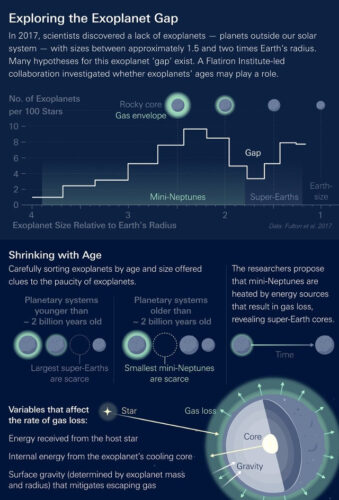
An infographic that illustrates the statistics of exoplanets with the radius gap and the possible mechanisms that make mini-Neptunes shrink until they turn into super-Earths

An article published in “The Astronomical Journal” reports a study on the scarcity of exoplanets with a radius between 1.5 and 2 times the Earth’s. A team of researchers led by Trevor David of the Flatiron Institute in New York studied what is commonly referred to as a radius gap using data collected by NASA’s Kepler Space Telescope. By dividing the exoplanets studied between those older than 2 billion years and those younger, the exam offers new information confirming the theory that sub-Neptunes can lose most of their atmosphere and transform into super-Earths even after billions of years.

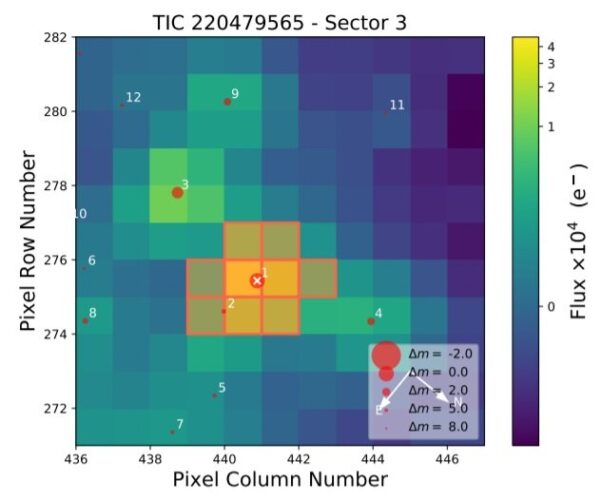
TOI-269 seen by TESS

An article accepted for publication in the journal “Astronomy & Astrophysics” reports the confirmation by a team of researchers led by Marion Cointepas of the exoplanet TOI-269 b, a sub-Neptune orbiting a red dwarf discovered thanks to NASA’s TESS space telescope. It’s a warm Sub-Neptune because its year only lasts 3.7 Earth days, as it’s very close to its star. It’s not the first case of that type, but this is interesting because estimates of its characteristics indicate that it’s close to the boundaries between sub-Neptunes and super-Earths. The loss of the atmosphere with the transformation from sub-Neptune to super-Earth is a case studied only in theory and TOI-269 b could provide useful information to understand this process.