Planets

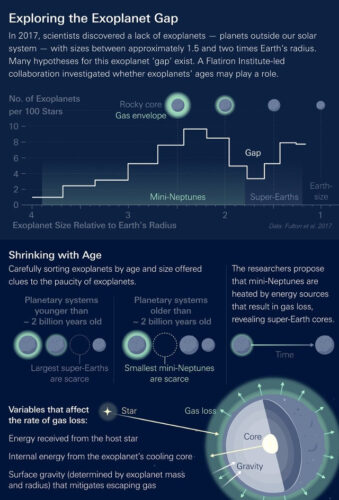
An infographic that illustrates the statistics of exoplanets with the radius gap and the possible mechanisms that make mini-Neptunes shrink until they turn into super-Earths

An article published in “The Astronomical Journal” reports a study on the scarcity of exoplanets with a radius between 1.5 and 2 times the Earth’s. A team of researchers led by Trevor David of the Flatiron Institute in New York studied what is commonly referred to as a radius gap using data collected by NASA’s Kepler Space Telescope. By dividing the exoplanets studied between those older than 2 billion years and those younger, the exam offers new information confirming the theory that sub-Neptunes can lose most of their atmosphere and transform into super-Earths even after billions of years.

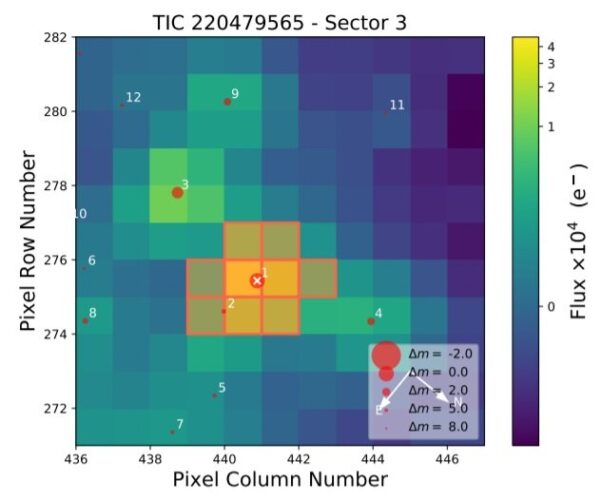
TOI-269 seen by TESS

An article accepted for publication in the journal “Astronomy & Astrophysics” reports the confirmation by a team of researchers led by Marion Cointepas of the exoplanet TOI-269 b, a sub-Neptune orbiting a red dwarf discovered thanks to NASA’s TESS space telescope. It’s a warm Sub-Neptune because its year only lasts 3.7 Earth days, as it’s very close to its star. It’s not the first case of that type, but this is interesting because estimates of its characteristics indicate that it’s close to the boundaries between sub-Neptunes and super-Earths. The loss of the atmosphere with the transformation from sub-Neptune to super-Earth is a case studied only in theory and TOI-269 b could provide useful information to understand this process.

Artist's concept of the Tianwen 1 mission's vehicles (Image courtesy CNSA / Chinese Academy of Sciences / Nature Astronomy)

A few hours ago the lander and rover of the Chinese Tianwen 1 mission landed successfully on the planet Mars, in the Utopia Planitia region. The event was confirmed by the Chinese space agency making China the third nation to land a vehicle on the red planet after the USA and the then USSR. The rover, which was named Zhurong, has a life expectancy of at least 90 days during which it will explore the area by making surveys with a series of instruments. The orbiter, which reached Mars together with the lander and rover on February 10, 2021, continues its work from above.

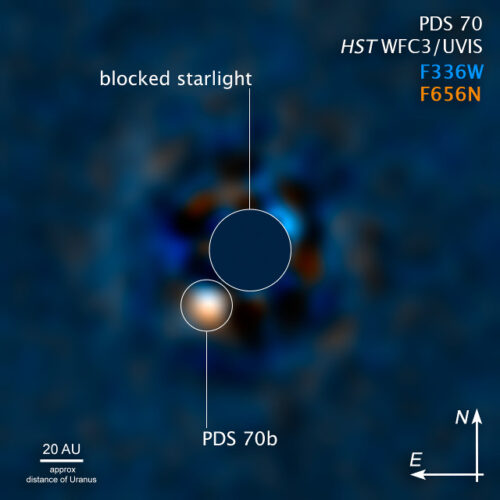
The PDS 70 system seen by Hubble

An article published in “The Astrophysical Journal” reports the first estimates of the growth of a young gas giant exoplanet. A team of researchers used observations conducted with the Hubble Space Telescope of the exoplanet PDS 70b exploiting its sensitivity to ultraviolets emitted by hot gas that gets swallowed by the young giant. This study opens the door to new possibilities for estimating the growth of gas giant planets.

Artist’s concept of Proxima Centauri during a superflare (Image NRAO/S. Dagnello)

An article published in “The Astrophysical Journal Letters” reports an analysis of a superflare of the star Proxima Centauri observed in 2019 in various bands of the electromagnetic spectrum. A team of researchers led by Meredith MacGregor of the University of Colorado at Boulder used various ground-based and space telescopes to obtain complete observations of a flare one hundred times more powerful than solar flares on the closest star to the Sun. It’s the most powerful flare ever observed on Proxima Centauri and one of the most powerful observed in the entire Milky Way.