
Planets

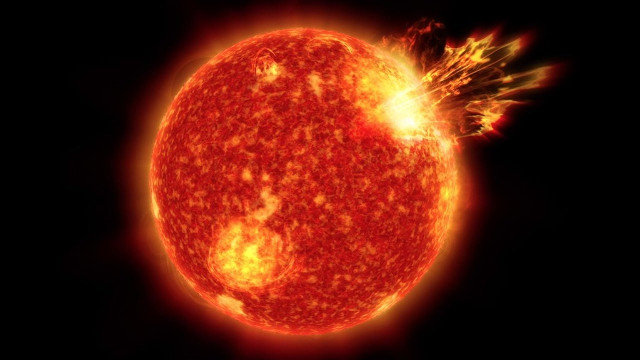
Artist's concept of what the Sun looked like 4 billion years ago (Image NASA's Goddard Space Flight Center/Conceptual Image Lab)

An article published in “The Astrophysical Journal” reports a study on the star Kappa 1 Ceti, very similar to the Sun in size and mass but much younger having an estimated age between 600 and 750 million years. A team of researchers coordinated by NASA’s Goddard Space Flight Center predicted some hard-to-measure features of Kappa 1 Ceti using computer models based on data collected by various NASA and ESA space telescopes. The results help to understand what the Sun looked like nearly four billion years ago, when it could emit superflares, to reconstruct the influence of its activity on early Earth and early life.

The PDS 70 system with the zoom on the protoplanet PDS 70 c

An article published in “The Astrophysical Journal Letters” reports a study on the circumplanetary disk around the exoplanet PDS 70 c. A team of researchers led by Myriam Benisty used the ALMA radio telescope to study what is still a protoplanet and the disk of materials around it that could form moons. According to estimates, there’s enough mass to form up to three moons the size of the Earth’s Moon. This type of study offers new information both on the formation of planets, especially gas giants, and on moons, one of the frontiers astronomers are trying to open.

Scheme of Jupiter's X-ray auroras

An article published in the journal “Science” reports a study on the planet Jupiter’s auroras that offers a solution to the mystery of X-ray emissions. A team of researchers obtained the crucial information thanks to data collected by ESA’s XMM-Newton space telescope and NASA’s Juno space probe. That allowed them to understand how ions are transported by the electromagnetic waves present in the Jovian magnetic field to the planet’s atmosphere, with which they collide to generate the auroras.

The free-floating planet CFBDSIR 2149-0403 (Image ESO/P. Delorme)

An article published in the journal “Monthly Notices of the Royal Astronomical Society” reports the identification of candidate gravitational microlens events that could be the traces of free-floating planets, which are planets that do not orbit any star. A team of researchers led by Iain McDonald used data obtained in 2016 during NASA’s Kepler Space Telescope K2 mission while monitoring a star-filled area near the center of the Milky Way. The result is the discovery of 27 signals generated by possible gravitational microlenses which lasted between one hour and 10 days. The four shortest events are consistent with Earth-sized planets.

Occator Crater on the dwarf planet Ceres and the structure of the ammonium molecule (Image NASA/JPL-Caltech/UCLA/MPS/DLR/IDA)

An article published in the journal “Nature Communications” reports a study of the origin of the ammoniated phyllosilicates present on the dwarf planet Ceres. A team of researchers conducted lab experiments based on the simulation of the Ceres environment. The results confirm the hypothesis that this dwarf planet formed in an area of ​​the solar system where ammonia ice is stable. However, they can’t rule out that it formed in the asteroid belt.