Planets

Artist's concept of the Tianwen 1 mission's vehicles (Image courtesy CNSA / Chinese Academy of Sciences / Nature Astronomy)

A few hours ago the lander and rover of the Chinese Tianwen 1 mission landed successfully on the planet Mars, in the Utopia Planitia region. The event was confirmed by the Chinese space agency making China the third nation to land a vehicle on the red planet after the USA and the then USSR. The rover, which was named Zhurong, has a life expectancy of at least 90 days during which it will explore the area by making surveys with a series of instruments. The orbiter, which reached Mars together with the lander and rover on February 10, 2021, continues its work from above.

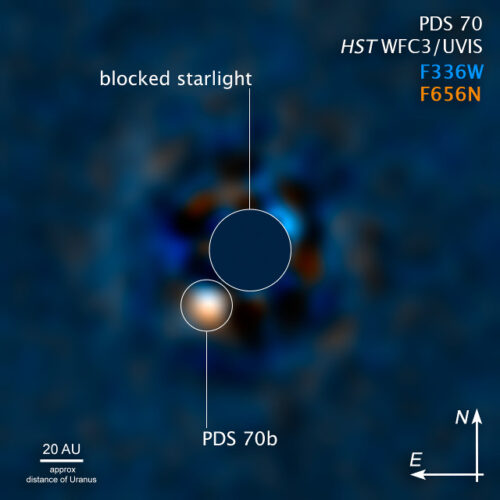
The PDS 70 system seen by Hubble

An article published in “The Astrophysical Journal” reports the first estimates of the growth of a young gas giant exoplanet. A team of researchers used observations conducted with the Hubble Space Telescope of the exoplanet PDS 70b exploiting its sensitivity to ultraviolets emitted by hot gas that gets swallowed by the young giant. This study opens the door to new possibilities for estimating the growth of gas giant planets.

Artist’s concept of Proxima Centauri during a superflare (Image NRAO/S. Dagnello)

An article published in “The Astrophysical Journal Letters” reports an analysis of a superflare of the star Proxima Centauri observed in 2019 in various bands of the electromagnetic spectrum. A team of researchers led by Meredith MacGregor of the University of Colorado at Boulder used various ground-based and space telescopes to obtain complete observations of a flare one hundred times more powerful than solar flares on the closest star to the Sun. It’s the most powerful flare ever observed on Proxima Centauri and one of the most powerful observed in the entire Milky Way.

The Ingenuity helicopter's shadow (Photo NASA/JPL-Caltech)

Yesterday, the Ingenuity helicopter conducted its first flight on planet Mars. The duration was only 40 seconds and it reached an altitude of just over 3 meters but it was important to lift off the ground this drone built to test the technologies needed to fly a vehicle in the Martian atmosphere, which is very thin. The flight was autonomous, pre-scheduled, and initiated by a command launched from Earth. The images, along with telemetry data, were transmitted to the Mars Rover Perseverance mission control center.

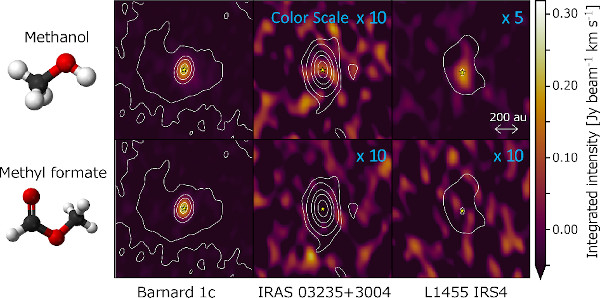
Distribution of molecular gas around some observed protostars in the Perseus Molecular Cloud

An article published in “The Astrophysical Journal” reports a study of organic molecules detected in 50 regions of protoplanetary disk formation in the Perseus Molecular Cloud. A team of researchers coordinated by the RIKEN Cluster for Pioneering Research used the ALMA radio telescope to detect the various molecules present in that molecular cloud, discovering that the distribution of complex organic molecules varies greatly in different areas. The composition was similar in young protoplanetary disks.