Planets

The SU Aurigae system (Image ESO/Ginski et al.)

An article published in “The Astrophysical Journal Letters” reports a research on the very young star SU Aurigae, or simply SU Aur, and on the protoplanetary disk around it. A team of researchers used new observations conducted with the SPHERE instrument on the VLT, combining them with old observations conducted with the NaCo instrument, also on the VLT, with the Hubble Space Telescope, and with the ALMA radio telescope to study the disk. It has a sort of tail of dust that comes from a nebula that is probably the result of a collision between the star and a cloud of gas and dust.

The first image of Mars captured by the Mars Rover Perseverance (Photo NASA/JPL-Caltech)

A few hours ago, the Mars Rover Perseverance and the Ingenuity helicopter landed successfully on Mars, in Jezero Crater. Launched on July 30, 2020, these are the two vehicles of NASA’s Mars 2020 mission. With more than 1,000 kg of weight on Earth, Perseverance even surpasses the Mars Rover Curiosity, of which it’s an evolution. For at least a Martian year, it will examine the area of ​​a geologically very interesting crater, collecting samples that mighy be returned to Earth by a future mission.

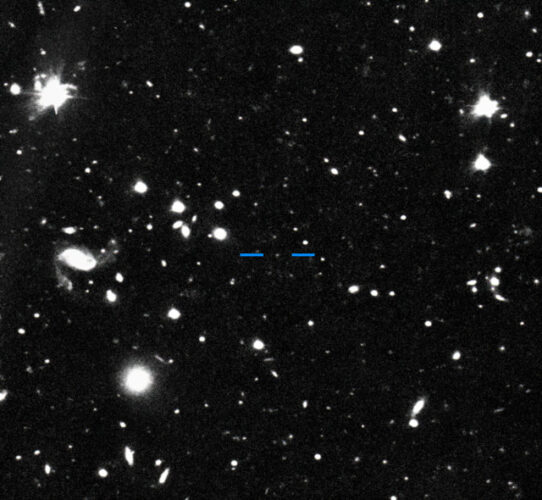
Farfarout (2018 AG37) seen on January 15, 2018, by the Subaru telescope (Image courtesy S. Sheppard)

A team of astronomers announced that they obtained observations confirming that 2018 AG37, nicknamed Farfarout, is the most distant object from the Sun within the solar system. Scott Sheppard of the Carnegie Institution for Science and his colleagues Chad Trujillo and David Tholen are specialists in researching objects in the Kuiper Belt and had identified this object already in 2018. However, it’s so far away that there were uncertainties about its measurements. and only now have astronomers announced that it’s currently at a distance from the Sun estimated at 132 times the Earth’s. Its distance exceeds that of 2018 VG18, nicknamed Farout, discovered by the same astronomers.

Mars seen by Tianwen 1 (Photo courtesy CNSA/CASC)

Yesterday, the Tianwen 1 mission reached the planet Mars, and the spacecraft which includes a space probe, a lander, and a rover entered its orbit correctly. Launched on July 23, 2020, it’s an ambitious mission for China with plans to explore Mars in various ways after successfully starting various missions to the Moon. The main spacecraft engined burned for about 15 minutes to perform the braking maneuver needed to enter an orbit that will reach up to 400 kilometers of altitude. The landing timeline and location in the Utopia Planitia region of the lander and rover will be decided later for a phase of the mission that could take place in May or June.

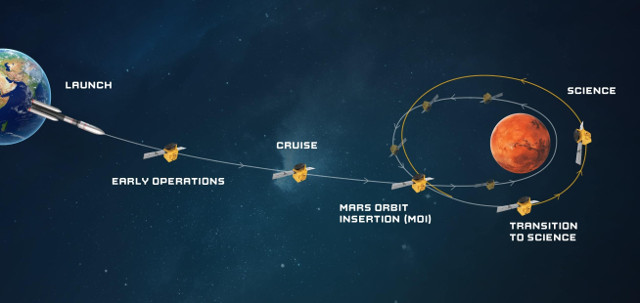
Infographic of the Hope space probe's journey

Yesterday, the Arab space probe Hope, or Al Amal, correctly entered the planet Mars orbit. Launched on July 20, 2020, Hope kept its six engines burning for 27 minutes to slow down to the speed needed to enter orbit, an automated maneuver that required absolute precision to prevent the spacecraft from going over Mars or crashing to the Martian surface. The lights of the tallest skyscraper in the world, the Burj Khalifa in Dubai, were switched on to celebrate the success of the first Arab mission.