Planets

Mars seen by Tianwen 1 (Photo courtesy CNSA/CASC)

Yesterday, the Tianwen 1 mission reached the planet Mars, and the spacecraft which includes a space probe, a lander, and a rover entered its orbit correctly. Launched on July 23, 2020, it’s an ambitious mission for China with plans to explore Mars in various ways after successfully starting various missions to the Moon. The main spacecraft engined burned for about 15 minutes to perform the braking maneuver needed to enter an orbit that will reach up to 400 kilometers of altitude. The landing timeline and location in the Utopia Planitia region of the lander and rover will be decided later for a phase of the mission that could take place in May or June.

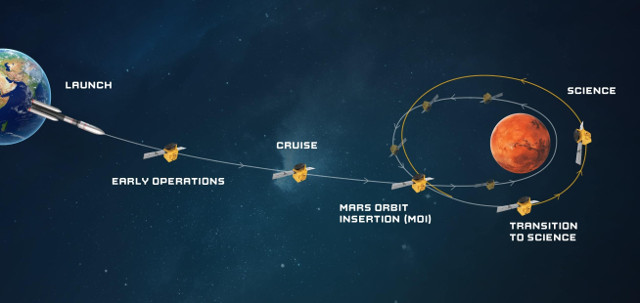
Infographic of the Hope space probe's journey

Yesterday, the Arab space probe Hope, or Al Amal, correctly entered the planet Mars orbit. Launched on July 20, 2020, Hope kept its six engines burning for 27 minutes to slow down to the speed needed to enter orbit, an automated maneuver that required absolute precision to prevent the spacecraft from going over Mars or crashing to the Martian surface. The lights of the tallest skyscraper in the world, the Burj Khalifa in Dubai, were switched on to celebrate the success of the first Arab mission.

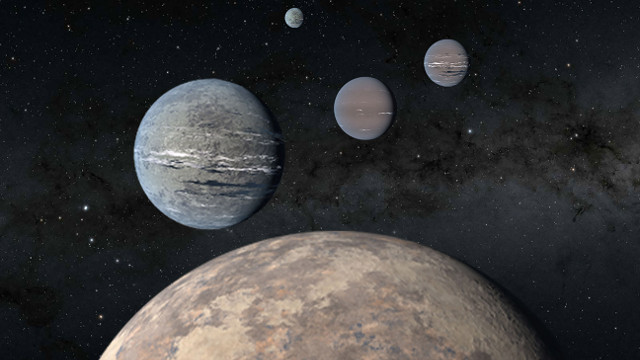
Artist's concept of the planets orbiting HD 108236 (Image NASA/JPL-Caltech)

An article published in “The Astronomical Journal” reports the confirmation of four exoplanets, one super-Earth and three mini-Neptunes, in the system of the star HD 108236. A team led by Tansu Daylan, postdoc Kavli Institute for Astrophysics and Space Research at MIT, analyzed data collected by NASA’s TESS space telescope to identify those exoplanets. Two high school students also participated in this research as part of the Student Research Mentoring Program (SRMP) at the Center for Astrophysics | Harvard & Smithsonian. An article accepted for publication in the journal “Astronomy & Astrophysics” reports the discovery of another super-Earth in the same system by a team of researchers led by Andrea Bonfanti of the Austrian Academy of Sciences that used ESA’s CHEOPS space telescope.

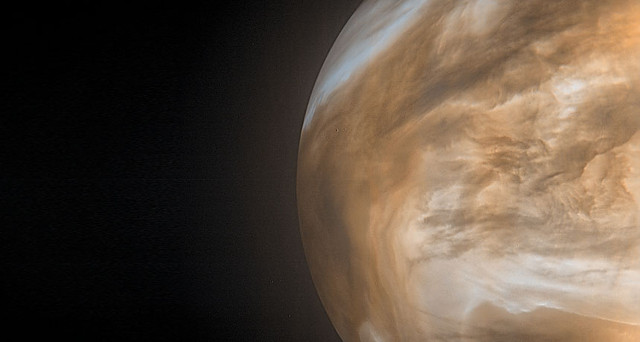
The night side of Venus seen by the Akatsuki space probe (Image courtesy JAXA / ISAS / DARTS / Damia Bouic)

An article accepted for publication in “The Astrophysical Journal” reports research that offers an alternative explanation to the presence of phosphine on Venus. A team of researchers used a robust model of the conditions in Venus’s atmosphere reanalyzing the data that led to the conclusion that there was phosphine. The new conclusion is that the data are consistent with the presence of sulfur dioxide.

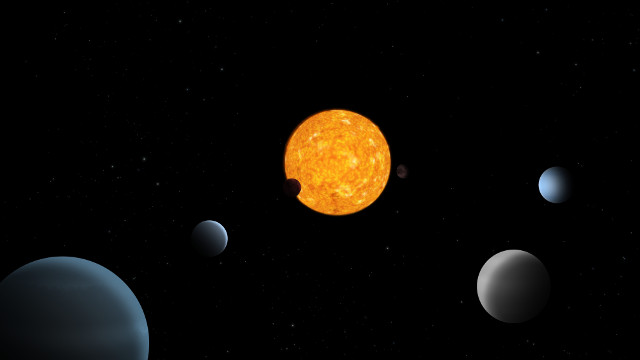
Artist’s impression of the TOI-178 planetary system (Image ESA)

An article published in the journal “Astronomy & Astrophysics” reports a study on the TOI-178 system that confirms the presence of six planets and indicates that the orbits of five of them are in resonance. A team of researchers led by Adrien Leleu of the Université de Genève and the University of Bern, Switzerland, used ESA’s CHEOPS space telescope and other instruments to confirm that there are at least six planets orbiting TOI-178. The result is a unique situation, with very different planets of which five follow a 2:4:6:9:12 resonance pattern.