Planets

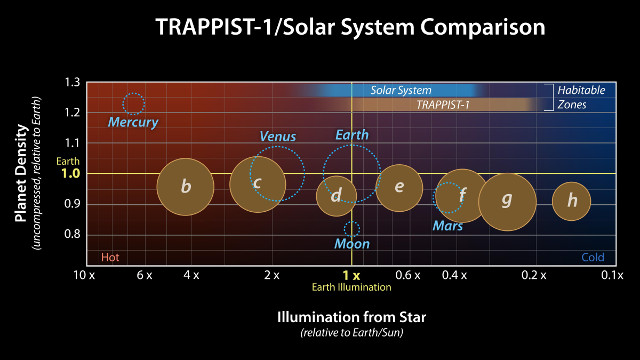
A comparison between the densities and illumination of the TRAPPIST-1 planets and the solar system's rocky planets with respect to Earth

An article published in the “Planetary Science Journal” reports a study on the seven planets of the ultra-cool dwarf star TRAPPIST-1’s system. A team of researchers led by astrophysicist Eric Agol of the University of Washington used data collected by the Spitzer Space Telescope over four years, by the Hubble and Kepler space telescopes, and by ground-based telescopes to obtain precise measurements of the planets’ masses and densities. The new calculations indicate that the seven planets have a very similar density, a new clue in the study of their composition with the possible similarities and differences compared to the rocky planets in the solar system.

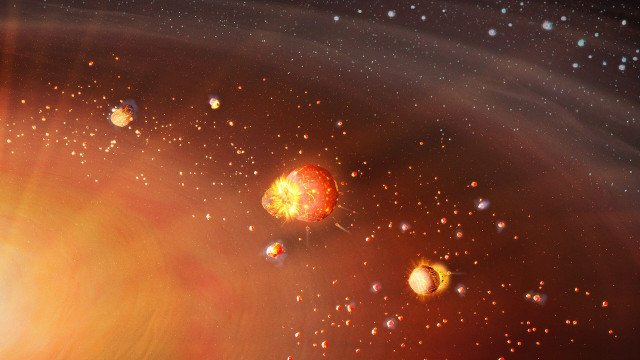
An artistic representation of the formation of the two planetary populations in the solar system

An article published in the journal “Science” reports a study that offers an explanation for the structure of the solar system with the different characteristics of the inner rocky planets and the outer gas planets. A team of researchers led by Dr. Tim Lichtenberg of the British University of Oxford put together information on other star systems in their formation phase and on the contents of meteorites to create simulations of the origin of the solar system. The conclusion is that it occurred in two phases, first the rocky planets and then the gas planets.

Artist's concept of the TOI-942 system (Image courtesy Italian National Institute of Astrophysics)

An article published in the journal “Astronomy & Astrophysics” reports the identification of two hot Neptunian exoplanets in the TOI-942 system. A team of researchers led by Ilaria Carleo of Wesleyan University, USA, and associated with the Italian National Institute of Astrophysics, Padua, used observations conducted with NASA’s TESS space telescope to find the exoplanet candidates, subsequently confirmed with follow-up observations conducted with the HARPS-N instrument mounted on the Galileo National Telescope, Canary Islands, and the REM instrument at the La Silla observatory, Chile. With an estimated age between 30 and 80 million years, it’s the youngest planetary system discovered thanks to TESS, excellent for studying planet evolution.

Hot spots on Jupiter

New discoveries on the planet Jupiter made thanks to the work of NASA’s Juno space probe were presented at the American Geophysical Union’s fall conference, which was virtual this year. In particular, new information was collected regarding the so-called hot spots, areas of the Jovian atmosphere that are denser and warmer than expected. Juno made it possible to obtain data that suggests that they’re larger and deeper than previously thought. Another news on Jupiter is that the new cyclone discovered last year at the planet’s south pole has dissolved.

The TOI-561 system

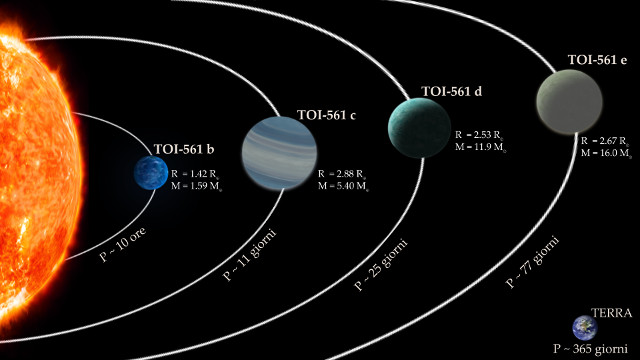
An article published in the journal “Monthly Notices of the Royal Astronomical Society” reports a study on the planetary system of the star TOI-561, which includes a super-Earth and three mini-Neptune. A team of researchers used data from NASA’s TESS space telescope and follow-up research with the HARPS-N spectrograph mounted on the Galileo National Telescope (TNG) on the Canary Island of La Palma to distinguish the traces of the planets and to measure some of their characteristics.