Planets

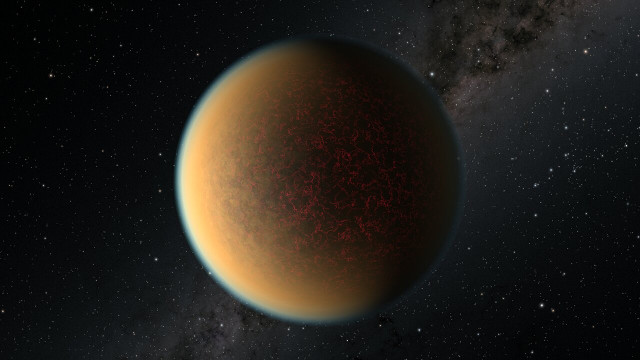
An artist’s impression of the exoplanet GJ 1132 b (Image NASA, ESA, and R. Hurt (IPAC/Caltech))

An article to be published in “The Astronomical Journal” reports a study on the atmosphere of the exoplanet GJ 1132 b which indicates that it may have lost its original atmosphere and that a new one was subsequently formed as a result of volcanic activity. A team of researchers led by Mark Swain of NASA’s Jet Propulsion Laboratory used observations conducted with the Hubble Space Telescope to detect the presence of an atmosphere containing hydrogen, hydrogen cyanide, methane, and ammonia with hydrocarbon hazes. According to the researchers, GJ 1132 b may have originated as a sub-Neptune, lost its original atmosphere because it’s very close to its star and therefore very hot, and what is now being detected is a new atmosphere generated by volcanic activity.

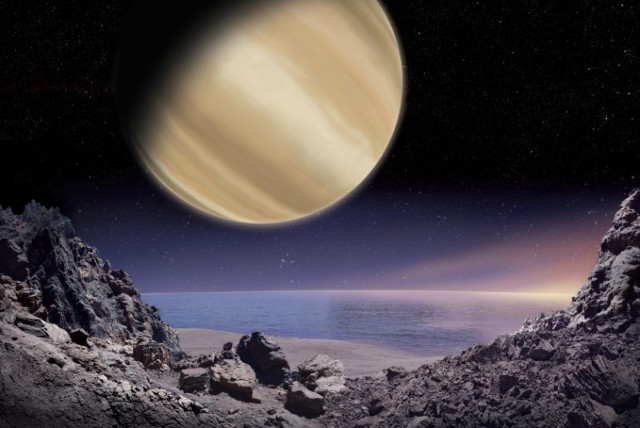
Artist's concept of Planet Pirx seen from a possible moon (Image courtesy M. Mizera / Pta / Iau100)

An article published in the journal “Astronomy and Astrophysics” reports the discovery of 26 planetary systems within the TAPAS (Tracking Advanced Planetary Systems) project. A team of researchers led by Professor Andrzej Niedzielski of the Institute of Astronomy at the NCU (Nicolaus Copernicus University) in Torun, Poland, used over a decade of observations with the Hobby-Eberly Telescope and the Galileo National Telescope to locate the traces of exoplanets around old stars, mostly now red giants, the last phase of their life. For their masses very similar to the Sun’s, three stars in particular have been defined as the Sun’s elder sisters.

The SU Aurigae system (Image ESO/Ginski et al.)

An article published in “The Astrophysical Journal Letters” reports a research on the very young star SU Aurigae, or simply SU Aur, and on the protoplanetary disk around it. A team of researchers used new observations conducted with the SPHERE instrument on the VLT, combining them with old observations conducted with the NaCo instrument, also on the VLT, with the Hubble Space Telescope, and with the ALMA radio telescope to study the disk. It has a sort of tail of dust that comes from a nebula that is probably the result of a collision between the star and a cloud of gas and dust.

The first image of Mars captured by the Mars Rover Perseverance (Photo NASA/JPL-Caltech)

A few hours ago, the Mars Rover Perseverance and the Ingenuity helicopter landed successfully on Mars, in Jezero Crater. Launched on July 30, 2020, these are the two vehicles of NASA’s Mars 2020 mission. With more than 1,000 kg of weight on Earth, Perseverance even surpasses the Mars Rover Curiosity, of which it’s an evolution. For at least a Martian year, it will examine the area of ​​a geologically very interesting crater, collecting samples that mighy be returned to Earth by a future mission.

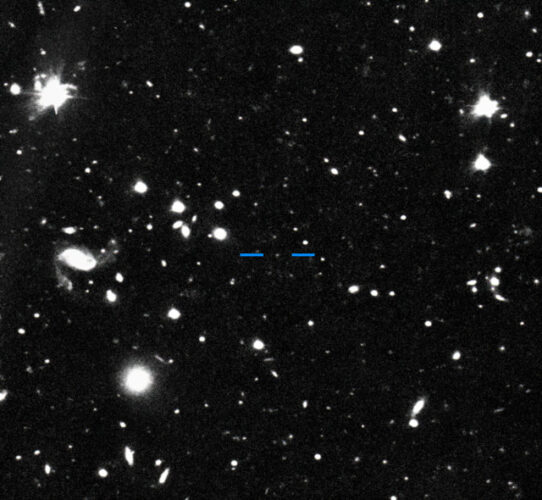
Farfarout (2018 AG37) seen on January 15, 2018, by the Subaru telescope (Image courtesy S. Sheppard)

A team of astronomers announced that they obtained observations confirming that 2018 AG37, nicknamed Farfarout, is the most distant object from the Sun within the solar system. Scott Sheppard of the Carnegie Institution for Science and his colleagues Chad Trujillo and David Tholen are specialists in researching objects in the Kuiper Belt and had identified this object already in 2018. However, it’s so far away that there were uncertainties about its measurements. and only now have astronomers announced that it’s currently at a distance from the Sun estimated at 132 times the Earth’s. Its distance exceeds that of 2018 VG18, nicknamed Farout, discovered by the same astronomers.