Planets

Artist's concept of the TOI-942 system (Image courtesy Italian National Institute of Astrophysics)

An article published in the journal “Astronomy & Astrophysics” reports the identification of two hot Neptunian exoplanets in the TOI-942 system. A team of researchers led by Ilaria Carleo of Wesleyan University, USA, and associated with the Italian National Institute of Astrophysics, Padua, used observations conducted with NASA’s TESS space telescope to find the exoplanet candidates, subsequently confirmed with follow-up observations conducted with the HARPS-N instrument mounted on the Galileo National Telescope, Canary Islands, and the REM instrument at the La Silla observatory, Chile. With an estimated age between 30 and 80 million years, it’s the youngest planetary system discovered thanks to TESS, excellent for studying planet evolution.

Hot spots on Jupiter

New discoveries on the planet Jupiter made thanks to the work of NASA’s Juno space probe were presented at the American Geophysical Union’s fall conference, which was virtual this year. In particular, new information was collected regarding the so-called hot spots, areas of the Jovian atmosphere that are denser and warmer than expected. Juno made it possible to obtain data that suggests that they’re larger and deeper than previously thought. Another news on Jupiter is that the new cyclone discovered last year at the planet’s south pole has dissolved.

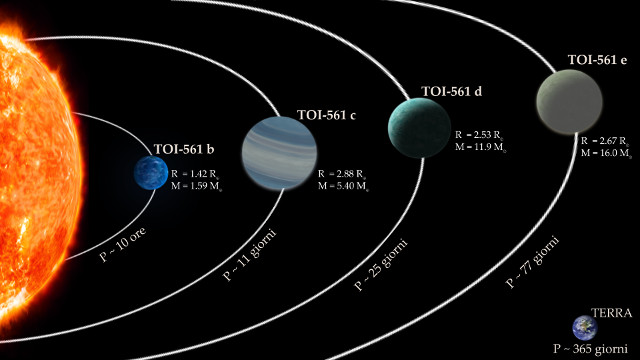
The TOI-561 system

An article published in the journal “Monthly Notices of the Royal Astronomical Society” reports a study on the planetary system of the star TOI-561, which includes a super-Earth and three mini-Neptune. A team of researchers used data from NASA’s TESS space telescope and follow-up research with the HARPS-N spectrograph mounted on the Galileo National Telescope (TNG) on the Canary Island of La Palma to distinguish the traces of the planets and to measure some of their characteristics.

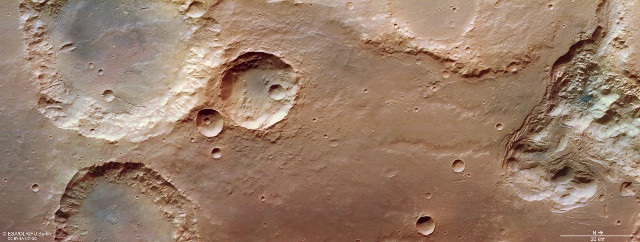
Chaotic terrain in Mars Pyrrhae Regio seen by Mars Express

ESA has released new images captured by its Mars Express space probe’s High Resolution Stereo Camera (HRSC) in Pyrrhae Regio, a region close to the Valles Marineris system on planet Mars. This is what is called chaotic terrain of the kind that forms when there’s underground ice that melts causing large amounts of water to be released. Such a process requires a significant amount of heat, which may have been provided by volcanic activity or a meteor impact. The current look is what is left after the water drained away, leaving in particular the geological formations called mesas.

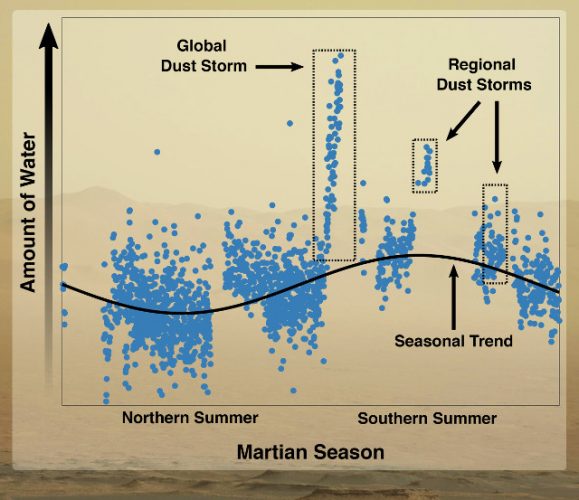
A depiction of water in Mars' atmosphere with peaks during periods of both regional and global dust storms

An article published in the journal “Science” reports a study that explains where most of the water that the planet Mars possessed when it was young, when it was in the liquid state on its surface, has gone. A team of researchers led by Shane Stone of the University of Arizona, USA, used data collected by NASA’s MAVEN space probe to track the movements of water in the atmosphere, up to high altitudes, where there are reactions that break it down and produce atomic hydrogen that is dispersed in space. This study highlighted the role of dust storms in water loss.