Planets

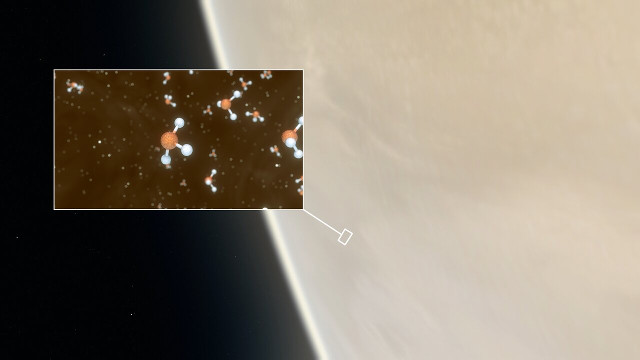
Artistic concept of Venus with the phosphine molecule in the inset (Image ESO/M. Kornmesser/L. Calçada & NASA/JPL/Caltech)

An article published in the journal “Nature Astronomy” reports the discovery of phosphine in the clouds of the planet Venus. A team of researchers led by astrophysicist Jane Greaves of the British University of Cardiff used the James Clerk Maxwell Telescope (JCMT) in Hawaii and the ALMA radio telescope to probe the Venusian atmosphere. The concentration of phosphine detected is about twenty parts per billion, which may seem little, but as far as we know only anaerobic bacteria can produce it in that amount. For this reason, phosphine is considered a biological signature in the study of the atmospheres of exoplanets even if at the moment it’s not possible to completely rule out an abiotic process that can produce phosphine in the conditions of Venus’s atmosphere.

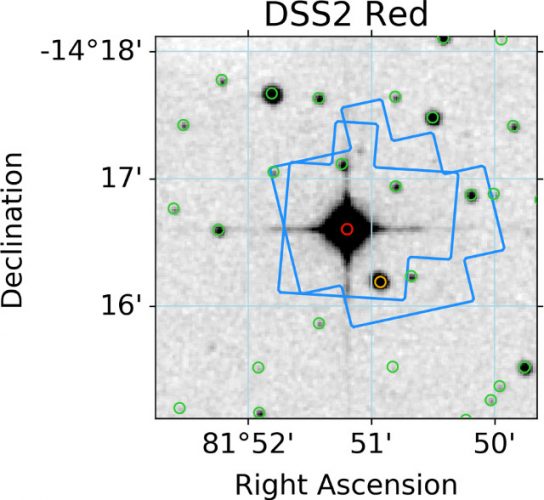
The TOI-421 system, in the DDS2

An article published in “The Astronomical Journal” reports the results of a study of the TOI-421 system, where two exoplanets were discovered following observations conducted by NASA’s TESS space telescope. A team of researchers led by Ilaria Carleo of Wesleyan University used various telescopes to conduct follow-up observations that confirmed the existence of the Neptunian exoplanet detected by TESS also discovering a radial velocity signal that led to the identification of a sub-Neptunian planet. Both are close to their star so they’re heated and their atmosphere is very large with a low density. In particular, the outer exoplanet is of the type that was called super puffy or cotton candy planet, difficult to explain for current models of atmospheric evolution.

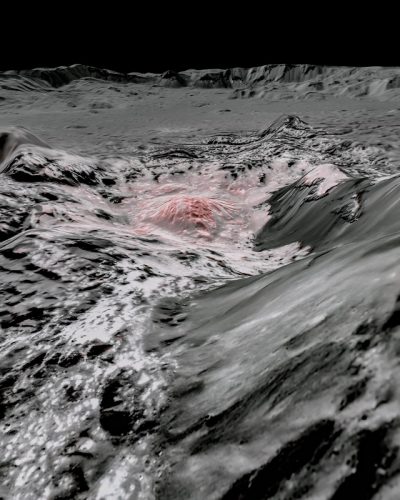
Cerealia Facula in Occator Crater

The Nature group has dedicated a special issue to the dwarf planet Ceres with a series of articles published in its journals. Various teams of researchers studied different aspects of the geology of Ceres with particular attention to the presence of water and hydrated sodium chloride, in very simple words table salt mixed with water. There are confirmations of the presence in the past of an underground ocean of which a strong presence of salts significantly lowered the freezing point. The salts present in the famous bright spots such as that in Occator Crater are among the remains of that ocean: they’re mainly sodium carbonate and ammonium chloride, but there’s also sodium chloride.

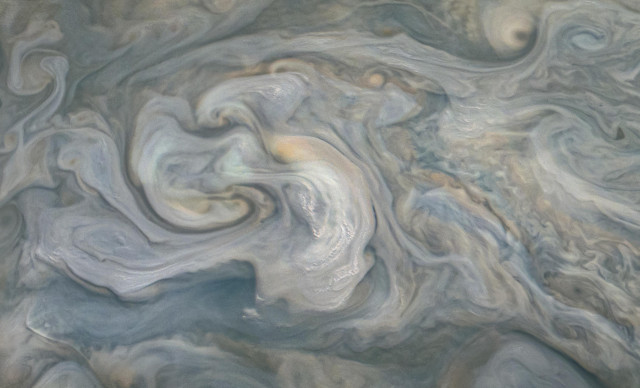
Clouds on Jupiter seen by Juno (Image NASA/JPL-Caltech/SwRI/MSSS/Kevin M. Gill © CC BY)

Three articles, one published in the journal “Nature” and two published in the journal “Geophysical Research: Planets”, report various aspects of research on the clouds of the planet Jupiter. Three teams of researchers with various members in common, coordinated by the French CNRS’s Laboratoire Lagrange and NASA’s JPL, used data collected by the Juno space probe to analyze various aspects of the role of water in the violent storms in the Jovian atmosphere. Lightning strikes originate in a solution of water and ammonia, substances that can form a sort of hailstones, nicknamed mushballs by the researchers, which play a key role in the atmospheric dynamics of this gas planet.

3D rendition of coronae on Venus (Image courtesy Laurent Montési / University of Maryland)

An article published in the journal “Nature Geoscience” reports the identification of 37 volcanoes that were active recently on the planet Venus. A team of researchers used models of thermo-mechanical activity under the surface of Venus to create 3D simulations of the formation of ring structures known as coronae that form when plumes of hot materials within the planet rise through the layers of the mantle and crust. This study offers what the authors claim is the best evidence ever found that Venus is still a geologically active planet.