Planets

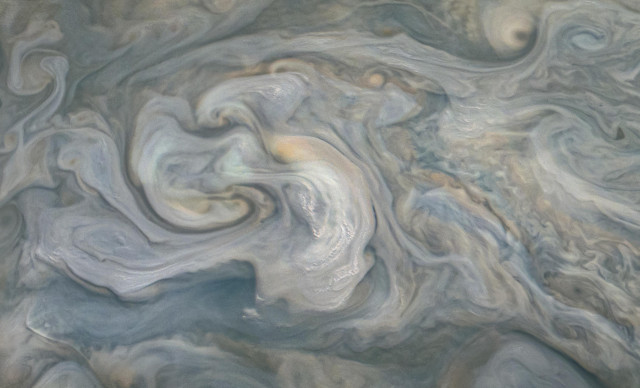
Clouds on Jupiter seen by Juno (Image NASA/JPL-Caltech/SwRI/MSSS/Kevin M. Gill © CC BY)

Three articles, one published in the journal “Nature” and two published in the journal “Geophysical Research: Planets”, report various aspects of research on the clouds of the planet Jupiter. Three teams of researchers with various members in common, coordinated by the French CNRS’s Laboratoire Lagrange and NASA’s JPL, used data collected by the Juno space probe to analyze various aspects of the role of water in the violent storms in the Jovian atmosphere. Lightning strikes originate in a solution of water and ammonia, substances that can form a sort of hailstones, nicknamed mushballs by the researchers, which play a key role in the atmospheric dynamics of this gas planet.

3D rendition of coronae on Venus (Image courtesy Laurent Montési / University of Maryland)

An article published in the journal “Nature Geoscience” reports the identification of 37 volcanoes that were active recently on the planet Venus. A team of researchers used models of thermo-mechanical activity under the surface of Venus to create 3D simulations of the formation of ring structures known as coronae that form when plumes of hot materials within the planet rise through the layers of the mantle and crust. This study offers what the authors claim is the best evidence ever found that Venus is still a geologically active planet.

WISEA J181006.18-101000.5

An article published in “The Astrophysical Journal” reports the discovery of two brown dwarfs thanks to the help of citizen scientists who participated in the Backyard Worlds: Planet 9 program. Cataloged as WISEA J041451.67-585456.7 and WISEA J181006.18-101000.5, those are two objects with masses that fall within the range typical of brown dwarfs but with other characteristics more similar to those of gas giant planets. They could be the first extreme T-type subdwarfs, and resemble ancient exoplanets, with very little iron, having an estimated age of around 10 billion years. Their characteristics make them useful to better understand exoplanets.

Jezero Crater on Mars

Two articles published in the journal “Icarus” report as many studies on Jezero Crater on Mars. Two teams of researchers used data collected by ESA’s Mars Express space probe to reconstruct various parts of the history of Jezero Crater which, with its approximately 49 kilometers in diameter, in the past used to host a lake. It dried out long ago, but left traces such as clay materials that only form in the presence of water. The diversity of minerals is also due to an ancient volcanic activity that affected the entire region. NASA’s Mars 2020 mission, with the Mars Rover Perseverance, will land in Jezero Crater, if all goes well, in February 2021 to also look for possible traces of life, present or past.

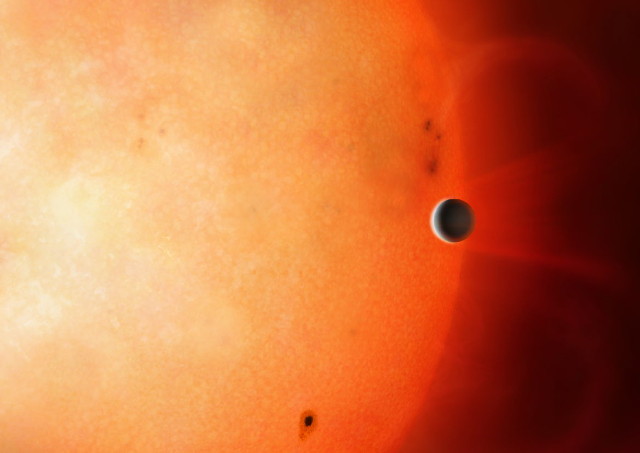
Artist’s impression showing a Neptune-sized planet in the Neptunian Desert (Image courtesy University of Warwick/Mark Garlick)

An article published in the journal “Nature” reports a study on the exoplanet TOI-849b, which appears to be the core of a gas giant stripped of its atmosphere. A team of researchers led by Dr. David Armstrong of the British University of Warwick used data collected by NASA’s TESS space telescope and ESO’s HARPS spectrograph to estimate the characteristics of TOI-849b. The result was that its mass is approximately 40 times the Earth’s with a size similar to Neptune’s, which means that its density is similar to the Earth’s. Its proximity to its star is probably the reason why it doesn’t have an atmosphere, although the possibility remains that it’s a sort of failed gas giant that couldn’t capture gas after the formation of the observed core.