Planets

Artist's concept of Kelt-9b and its star in the background (Image NASA's Goddard Space Flight Center/Chris Smith (USRA))

An article published in “The Astronomical Journal” reports a study on the characteristics of the orbit of the exoplanet KELT-9b, an ultra-hot Jupiter very close to its star. A team of researchers led by John Ahlers of the Exoplanets and Stellar Astrophysics Laboratory at NASA’s Goddard Space Flight Center used data collected by NASA’s TESS space telescope to create a model of the interaction between star and exoplanet that allowed to understand better the peculiar characteristics of the star and the extreme ones of KELT-9b. For example, it turned out that the star spins so fast that its poles are flattened making them hotter, and the exoplanet orbits around those poles with the consequence that it has two summers when it passes over them while it has two winters when it passes over the star’s equator.

HBC 672 seen by Hubble (Image NASA, ESA, and STScI)

An article published in “The Astrophysical Journal” reports multi-epoch observations conducted with the Hubble Space Telescope of the star HBC 672 and the movement of the shadow projected by its protoplanetary disk onto an interstellar cloud. A team of researchers led by Klaus Pontoppidan of the Space Telescope Science Institute (STScI) compared the positions of the shadow over 13 months, noting its movement, which has a visual effect similar to a flapping of wings as its shape reminds of that to the point that the star and its protoplanetary disk have been nicknamed Bat Shadow. It could be a planet that is forming and warping the disk.

Some stars and planets situations

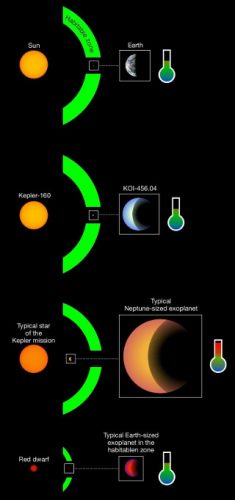
An article published in the journal “Astronomy & Astrophysics” reports the discovery of an exoplanet candidate with a very high probability of existence, a super-Earth designated as KOI-456.04 whose estimated year is slightly longer than the Earth’s that orbits Kepler-160, a Sun-like star. A team of researchers led by RenĂ© Heller of the Max Planck Institute for Solar System Research in Göttingen, Germany, analyzed old data accumulated by the Kepler space telescope using a new method based on the detailed physical model of the stellar brightness variation instead of the classic one based on the search for the tiny drops in brightness that occur when the planet passes between the star and the telescope. The analysis also led to the discovery of another exoplanet candidate designated as Kepler-160 d.

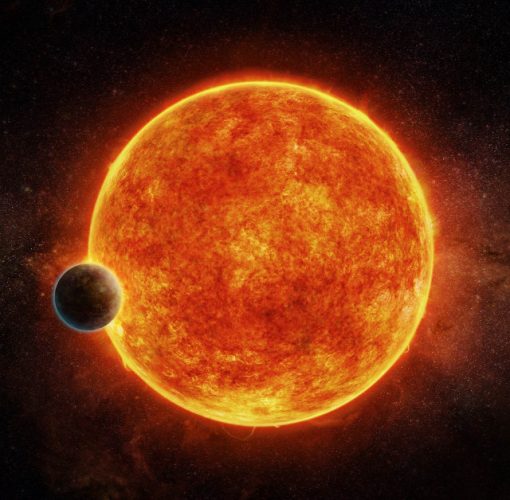
Artist's concept of a super-Earth with its star behind it (Image courtesy M. Weiss/CfA)

An article accepted for publication in the journal “Astronomy & Astrophysics” reports the discovery of a super-Earth in the system of HD 164922, a star that’s slightly smaller and slightly less massive than the Sun. A team of researchers led by Serena Benatti of the Italian National Institute for Astrophysics, Palermo, used the HARPS-N spectrograph installed on the Galileo Telescope, on the Canary Islands, to collect the data which, together with others previously collected with other instruments, allowed to discover the exoplanet designated as HD 164922d. The discoveries of exoplanets are increasingly made thanks to software that performs an automatic analysis of data collected by various telescopes, but in this case it’s the prize for the tenacity of astronomers who put together the data of years of observations conducted with various instruments.

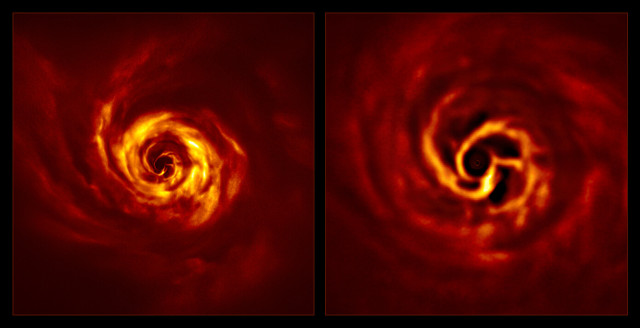
The AB Aurigae system seen by SPHERE

An article published in the journal “Astronomy & Astrophysics” reports evidence of the existence of a planet in formation in the protoplanetary disk surrounding the young star AB Aurigae. A team of researchers led by Anthony Boccaletti, of the Observatoire de Paris, PSL University, France, used the SPHERE instrument mounted on ESO’s VLT in Chile to find traces of what could be a planet. SPHERE takes real photos of the objects, so if the discovery was confirmed it would be the first direct evidence of a planet seen while it’s forming.