Planets

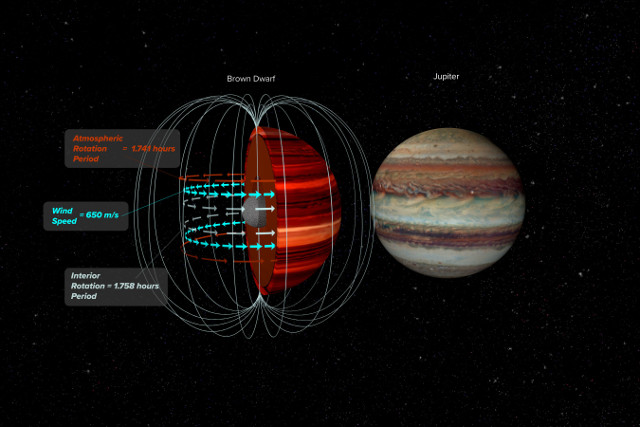
Illustration of brown dwarf and Jupiter

An article published in the journal “Science” reports the first measurement of the winds blowing in the atmosphere of the brown dwarf cataloged as 2MASS J10475385+2124234. A team of researchers led by Katelyn Allers of Bucknell University combined observations conducted with the Very Large Array (VLA) and NASA’s Spitzer space telescope to achieve this result. The method was already used for planets like Jupiter, so the news is its extension to a brown dwarf, and could also concern gaseous exoplanets.

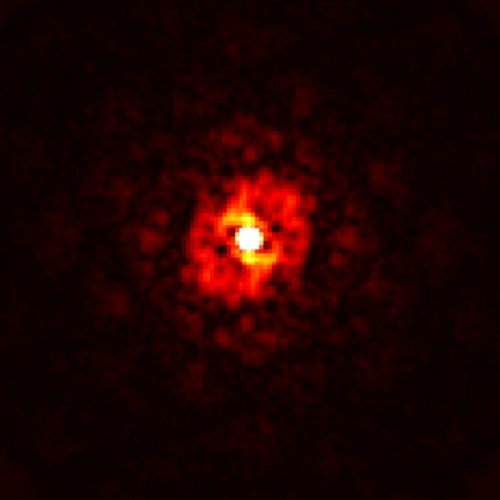
The star LHS 1815

An article published in “The Astronomical Journal” reports the discovery of the exoplanet LHS 1815b thanks to NASA’s TESS space telescope. A team of researchers led by Tianjun Gan of Tsinghua University in Beijing, China, confirmed the existence of that planet using various ground-based photometric, spectroscopic and photographic instruments. The conclusion is that its size is slightly higher than the Earth’s, but it’s much denser for a mass up to 8.7 times the Earth’s. The most unique feature is that it’s the first exoplanet discovered in the Milky Way’s so-called thick disk, one of the structures that make up about two thirds of disk galaxies.

Uranus seen by Voyager 2 (Image NASA/JPL-Caltech)

An article published in the journal “Geophysical Research Letters” reports the discovery of a plasmoid, a structure composed of plasma formed mainly of hydrogen in the midst of magnetic fields, in the magnetotail – the magnetosphere’s tail – of the planet Uranus that was moving away from it. The plasmoid’s formation isn’t a new event because Gina DiBraccio and Daniel J. Gershman of NASA’s Goddard Space Flight Center examined the observations made by the Voyager 2 space probe during the its Uranus flyby on January 24, 1986. It’s the first plasmoid discovered in the Uranus’ atmosphere and could be a crucial mechanism for its loss of atmosphere.

Two examples of aligned and misaligned protoplanetary disks around binary stars

An article published in “The Astrophysical Journal” reports a study on the orbits of protoplanetary disks in binary systems, where different geometries were found. A team of astronomers led by Ian Czekala of the University of California at Berkeley used the ALMA radio telescope to study star systems in formation around two stars, which in jargon are called circumbinary disks. The conclusion is that the disks that orbit the more compact binary systems share almost the same plane while the disks that orbit the wider binary systems have significantly tilted orbital planes.

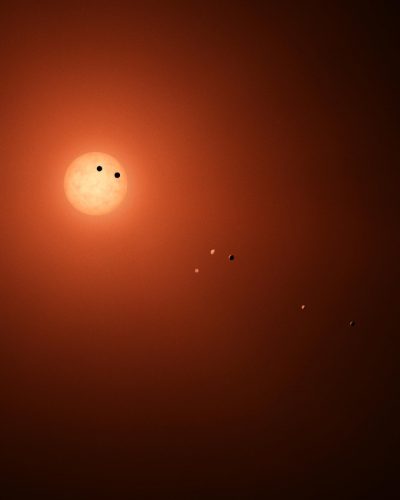
Artist's concept of TRAPPIST-1 and its planets (Image NASA/JPL-Caltech)

An article published in “The Astrophysical Journal” reports a study on the X-ray and ultraviolet (XUV) luminosity of TRAPPIST-1, the ultra-cool dwarf star that became famous after the confirmation that it has a system of 7 rocky planets. A team of researchers used a Markov Chain Monte Carlo method to calculate the radiation received over time by those planets concluding that the star had high levels of X-ray and ultraviolet emissions for several billion years causing its planets significant atmospheric erosion and loss of volatile compounds. The researchers also showed that the free / open source approxposterior software can replicate their analysis much faster than emcee, a software used for that type of calculation. This will help to study other red dwarfs to evaluate the habitability of the planets that are increasingly found orbiting red dwarfs.