Planets

Two examples of aligned and misaligned protoplanetary disks around binary stars

An article published in “The Astrophysical Journal” reports a study on the orbits of protoplanetary disks in binary systems, where different geometries were found. A team of astronomers led by Ian Czekala of the University of California at Berkeley used the ALMA radio telescope to study star systems in formation around two stars, which in jargon are called circumbinary disks. The conclusion is that the disks that orbit the more compact binary systems share almost the same plane while the disks that orbit the wider binary systems have significantly tilted orbital planes.

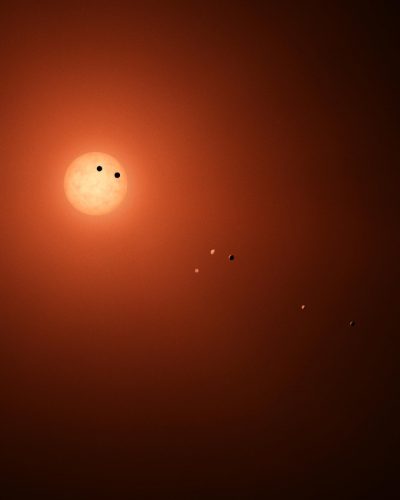
Artist's concept of TRAPPIST-1 and its planets (Image NASA/JPL-Caltech)

An article published in “The Astrophysical Journal” reports a study on the X-ray and ultraviolet (XUV) luminosity of TRAPPIST-1, the ultra-cool dwarf star that became famous after the confirmation that it has a system of 7 rocky planets. A team of researchers used a Markov Chain Monte Carlo method to calculate the radiation received over time by those planets concluding that the star had high levels of X-ray and ultraviolet emissions for several billion years causing its planets significant atmospheric erosion and loss of volatile compounds. The researchers also showed that the free / open source approxposterior software can replicate their analysis much faster than emcee, a software used for that type of calculation. This will help to study other red dwarfs to evaluate the habitability of the planets that are increasingly found orbiting red dwarfs.

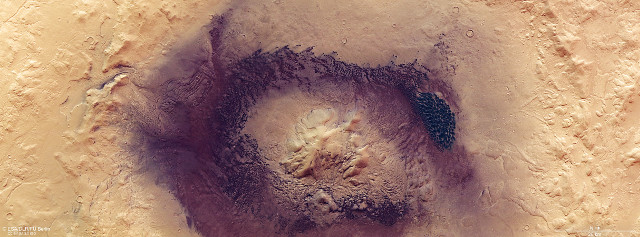
Moreux Crater on Mars

ESA has released new photos of Moreux Crater on the planet Mars taken by the Mars Express space probe’s High Resolution Stereo Camera (HRSC). It’s an impact crater, but shows characteristics that are out of normal, considered the result of erosion caused by glacial processes. Glaciations probably occurred in different periods since the geological traces present in the area suggest that they occurred even in the last millions of years. Another reason for interest in this crater is the presence of dunes inside it, which provide information on the winds blowing in the area.

Artist's concept of iron rain on the exoplanet WASP-76b (Image ESO/M. Kornmesser)

An article published in the journal “Nature” reports a study on the conditions existing on the exoplanet WASP-76b, an ultra-hot Jupiter where on the side illuminated by its star it’s so hot that metals vaporize and then condense on the dark side, where it rains iron. A team of researchers led by David Ehrenreich of the University of Geneva, Switzerland, used the ESPRESSO instrument mounted on the VLT in Chile to study the processes underway in the atmosphere of WASP-76b with the winds that carry the iron vapor across this gas giant.

Thiophene structure

An article published in the journal “Astrobiology” reports a study on the possible origin of organic compounds known as thiophenes discovered on Mars by NASA’s Mars Rover Curiosity. Jacob Heinz of the Technische Universität in Berlin and Dirk Schulze-Makuch of Washington State University described some possible processes leading to the formation of thiophenes. These possible processes can be non-biological or biological, and the problem is to find evidence that points to one of them. Thiophenes also exist on Earth and there’s a tendency to think that they’re formed as a result of biological processes, but on Mars this would mean that life forms exist.