Planets

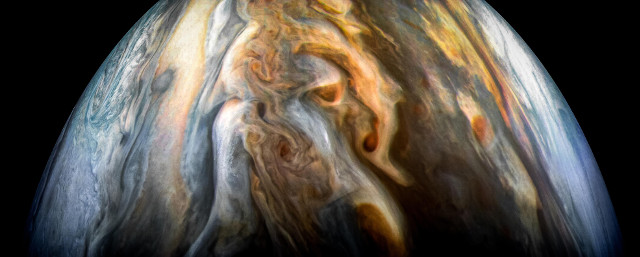
Jupiter's equatorial region

An article published in the journal “Nature Astronomy” reports a study on the abundance of water in the atmosphere and in particular in the equatorial region of the planet Jupiter. NASA’s Juno mission team used data collected by the space probe, which has been orbiting the gas giant for about 3.5 years. The conclusion is that water makes up about 0.25% of the molecules in Jupiter’s atmosphere, about three times those present in the Sun’s atmosphere estimated through the presence of its components. This is a result that indicates an abundance much higher than that measured in 1995 by the Galileo space probe.

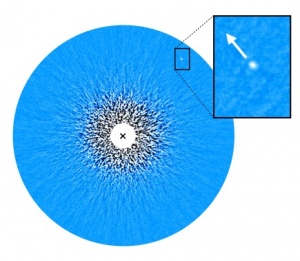
The brown dwarf GJ 504 B's system

An article published in “The Astronomical Journal” offers an explanation of the formation mechanisms of gas giant planets and brown dwarfs bringing evidence that these are two different mechanisms. A team of astronomers led by Brendan Bowler of the University of Texas, Austin, conducted observations at the Keck Observatory and with the Subaru Telescope, both in Hawaii, accompanied by computer simulations using the free / open source orbitize! software to try to understand if there were orbital differences that indicated a different origin between these objects. Their conclusion is that brown dwarfs have significantly more elliptical orbits.

Pluto

An article published in the “Journal of Geophysical Research” reports a study on the dwarf planet Pluto and in particular on the heart-shaped region called Tombaugh Regio and its influence on global atmospheric circulation. A team of researchers coordinated by NASA’s Ames Research Center used data collected by the New Horizons space probe to specifically study nitrogen circulation and its cycle appropriately compared to a heart beat. This is another confirmation that Pluto is an active small world despite its small size and thin atmosphere.

Artist's concept of the exoplanet KELT-9b (Image NASA/JPL-Caltech)

An article published in “The Astrophysical Journal Letters” reports a study of the exoplanet KELT-9b with evidence that the conditions are so extreme as to break hydrogen molecules. A team of researchers led by Megan Mansfield of the University of Chicago used NASA’s Spitzer space telescope to find evidence that KELT-9b is an extreme example even in the hot Jupiter planet class due to the conditions existing on its surface. Not accidentally, it’s the hottest known planet and on its dayside hydrogen molecules are broken and then recompose when the atoms move on its nightside.

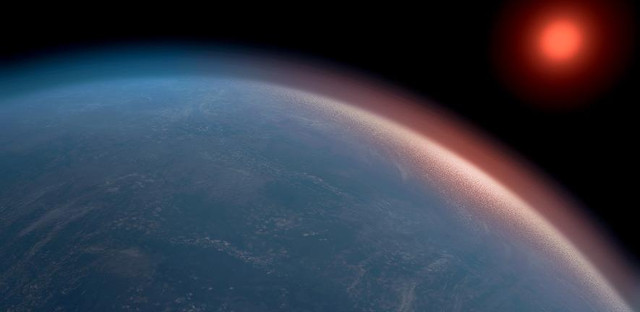
Artist's concept of the GJ180 system (Image Robin Dienel, courtesy of the Carnegie Institution for Science)

An article published in “The Astrophysical Journal Supplement Series” reports the identification of five new exoplanets, the detection of eight exoplanet candidates that will be verified, and the confirmation of three exoplanets previously detected but not yet confirmed. A team of astronomers led by Fabo Feng and Paul Butler of the Carnegie Institution for Science selected and reanalyzed data gathered in the survey conducted with the UVES instrument mounted on ESO’s VLT using other verification instruments. Two of the new exoplanets are super-Earths in their system’s habitable zone, the first of this type that orbit around red dwarfs not tidally locked,, a positive factor because having always day on one face and always night on the other generates extreme temperatures that lower the chances of life being born.