Planets

New confirmations that phosphorus was brought to Earth by comets

An article to be published in the journal “Monthly Notices of the Royal Astronomical Society” reports a study tracing the journey of phosphorus from star formation to comets. A team of researchers led by VĂ­ctor Rivilla of the Italian National Institute of Astrophysics used the ALMA radio telescope and data collected by ESA’s Rosetta space probe’s ROSINA instrument on comet 67P/Churyumov–Gerasimenko to understand where phosphorus is formed and how comets may have brought it to Earth, where it’s needed by life forms.

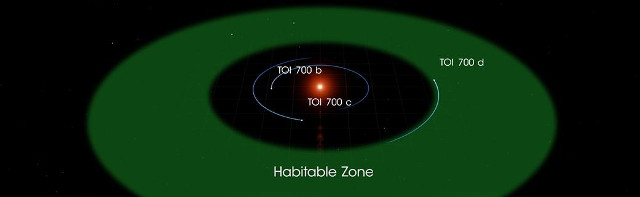
The exoplanet TOI 700 d is the first discovered by the TESS space telescope in its system's habitable zone

Three articles submitted for publication in “The Astrophysical Journal” report various aspects of a study of the TOI 700 system and the discovery of three exoplanets thanks to the observations made by NASA’s TESS space telescope. Several researchers collaborated to confirm the existence of the three exoplanets and to study their characteristics, in particular TOI 700 d, the outermost and the only one of the three to orbit in the habitable zone of its system. Its existence was also confirmed using the Spitizer space telescope making it the first rocky exoplanet discovered by TESS in the habitable zone.

Artist's concept of Sub-Neptune planet (Image NASA/ESA/G. Bacon (STScI)/L. Kreidberg & J. Bean (U. Chicago)/H. Knutson (Caltech) )

An article published in “The Astrophysical Journal Letters” offers an explanation of the abundance of sub-Neptune planets discovered compared to gas giants. A team of researchers led by Edwin Kite of the University of Chicago studied the characteristics of these planets offering as an explanation what they called fugacity crisis in reference to the term that measures how much more easily a gas dissolves into a mixture than it would be expected based on pressure. In the case of the sub-Neptune planets, the their atmosphere’s gas dissolve in the ocean of magma that probably covers the surface of their rocky core.

The "cotton candy exoplanets" of the Kepler 51 system studied with the Hubble Space Telescope

An article to be published in “The Astronomical Journal” reports a study on three gas exoplanets discovered in the Kepler 51 system belonging to a rare type that has a very low density even by the standards of these planets. A team of researchers led by Jessica Libby-Roberts, a graduate student at the University of Colorado, Boulder, used the Hubble Space Telescope to study those three exoplanets confirming their density so low as to deserve nicknames such as “cotton candy planets” or “super puffs”. This study suggests that they’re quickly losing mass so in the distant future they could turn into mini-Neptunes, a much more common category.

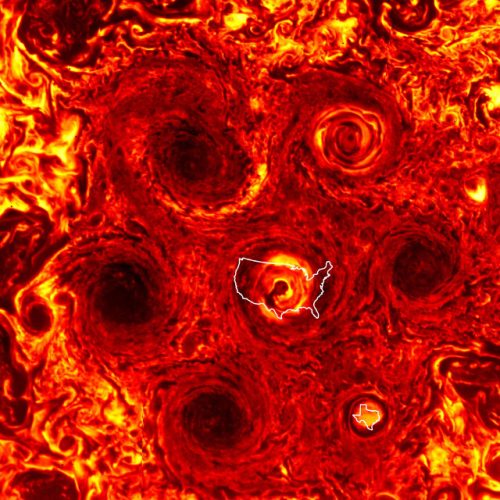
Jupiter's south pole seen by JIRAM

A new cyclone was discovered at the south pole of the planet Jupiter by NASA’s Juno space probe. In particular, it was the JIRAM instrument that captured the first images in which you can see that the configuration of the cyclones existing in that area changed from a pentagon of cyclones surrounding a central one to a hexagon, still around a central one. The new cyclone seems small compared to the ones already existing but its surface is comparable to that of Texas. This discovery was made during a Jupiter flyby that follows a maneuver needed to prevent Juno from ending up in the planet’s shadow for 12 hours. Without being powered by solar panels, its batteries would have completely drained and its temperature would have dropped to lethal levels.