Planets

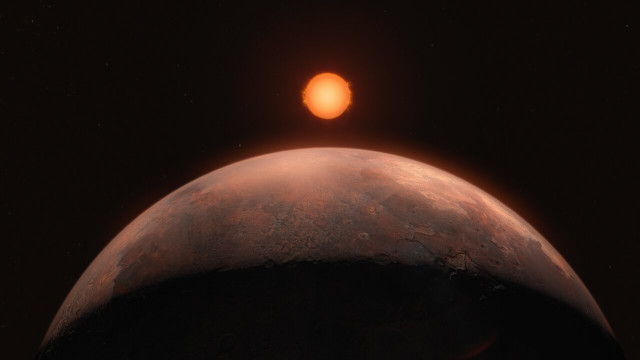
Artist’s impression of the exoplanet Barnard b with Barnard's Star in the background (Image ESO/M. Kornmesser)

An article published in the journal “Astronomy & Astrophysics” reports the identification of an exoplanet smaller than Earth orbiting Barnard’s Star. A team of researchers identified the exoplanet designated as Barnard b using the ESPRESSO instrument installed on ESO’s VLT in Chile. This discovery was later confirmed with other specialized exoplanet-hunting instruments: HARPS, HARPS-N, and CARMENES. The researchers also detected other signatures that suggest the presence of three exoplanet candidates, but follow-up investigations are needed to verify their existence.

An article published in the journal “Nature Astronomy” reports a possible reconstruction of the system of the ultra-cool dwarf star TRAPPIST-1 that led to the current configuration of its seven rocky planets. A team of researchers examined their orbits and in particular their orbital resonances, concluding that the planets formed in two steps in a protoplanetary disk divided into two parts. Initially, this led to the formation of two planetary subsystems and only later did planetary migrations occur with influences between various planets that led to the current situation.

A cutout of the interior of Mars beneath NASA's InSight lander with the dry upper crust and the mid-crust saturated with water

An article published in the journal “Proceedings of the National Academy of Sciences (PNAS)” reports the results of an analysis of seismic data collected on the planet Mars by NASA’s InSight lander that concludes that the mid-crust of Mars could be filled with liquid water that saturates a layer of igneous rock. Vashan Wright and Matthias Morzfeld of the Scripps Institution of Oceanography and Michael Manga of the University of Berkeley used models similar to those used to map aquifers and oil fields to try to understand the composition of deep layers of the Martian subsurface.

The best explanation for the data collected by the InSight mission is that between 11.5 and 20 kilometers deep there’s a layer of igneous rock saturated with liquid water. The depth makes it impossible to reach it but if the entire mid-crust of Mars were made like this, there would be enough water to form an ocean between one and two kilometers deep on the surface.

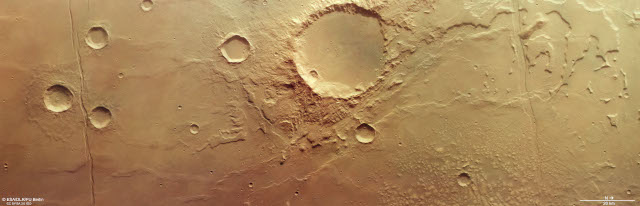
The Caralis Chaos on Mars

An image captured by ESA’s Mars Express space probe’s High Resolution Stereo Camera (HRSC) shows the region of the planet Mars called Caralis Chaos. At first glance, it may seem like just another Martian area dotted with craters and wind-carved mounds, but when the red planet was young, it was home to Lake Eridania, larger than all the lakes on Earth. It covered an area of ​​more than a million square kilometers, including Atlantis Chaos, an area close to Caralis Chaos. That lake gradually dried up as the environmental collapse transformed an Earth-like planet into the one we see today.

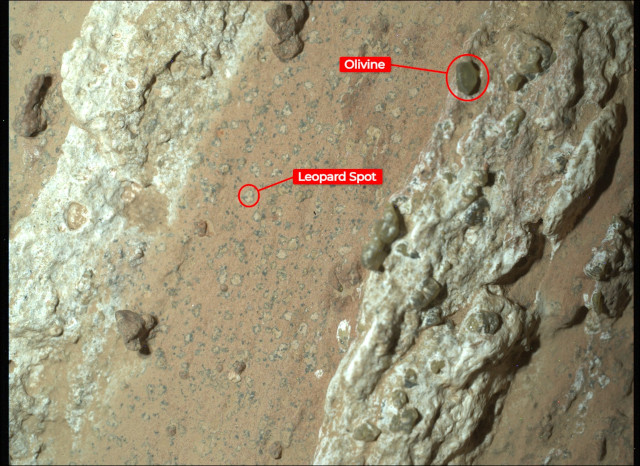
The Cheyava Falls Rock Found on Mars (Image NASA/JPL-Caltech/MSSS)

NASA’s Mars Rover Perseverance discovered a rock that contains chemical signatures and structures that might have been created by ancient Martian life forms. The rock, nicknamed Cheyava Falls, was found in Neretva Vallis during Perseverance’s journey inside Jezero Crater on Mars and was examined with the SHERLOC (Scanning Habitable Environments with Raman & Luminescence for Organics & Chemicals) instrument. The rock contains organic compounds, but it’s currently not possible to rule out that they formed through non-biological processes. The PIXL (Planetary Instrument for X-ray Lithochemistry) instrument detected iron and phosphates in black halos on the rock.