Planets

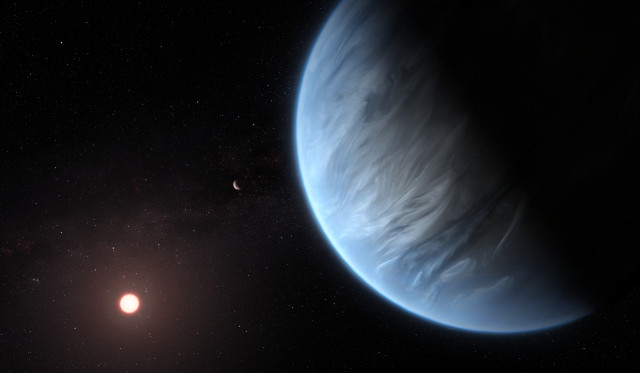
Artist's concept of K2-18b with its star in the background (Image ESA/Hubble, M. Kornmesser)

An article published in the journal “Nature Astronomy” reports the detection of water vapor in the exoplanet K2-18b’s atmosphere mainly thanks to the Hubble space telescope. This exoplanet is in ​​its system’s habitable zone and this made it interesting since this super-Earth was discovered in 2015. It’s the first detection of water vapor in an exoplanet of that type but it’s still too soon to assess its habitability potential because the detections are not precise enough to define the percentages of other molecules such as hydrogen and helium and to understand if there are clouds.

The star GJ 1061 (Image courtesy Centre de Données astronomiques de Strasbourg / SIMBAD / SDSS)

An article being published in the journal “Monthly Notices of the Royal Astronomical Society” reports the discovery of three super-Earths in the system of the red dwarf star GJ 1061. A team of astronomers from the Red Dots collaboration made this discovery during the 2018 observation campaign thanks to a series of spectroscopic detections obtained over three months using the radial velocity method. The masses of these exoplanets are a bit higher than the Earth’s and the outermost is in ​​its system’s habitable zone, where it receives an amount of energy from its star close to what the Earth receives from the Sun.

The vibrations of Saturn's rings used to reconstruct the impacts on the planet

An article published in “The Astrophysical Journal” reports a research on variations in the gravitational field of the planet Saturn due to internal vibrations. Yanqin Wu of the University of Toronto and Yoram Lithwick of Northwestern University used data collected by the Cassini space probe during its ring flybys to study the phenomenon, concluding that Saturn’s vibrations were caused by past impacts that made the planet sort of ring like a bell.

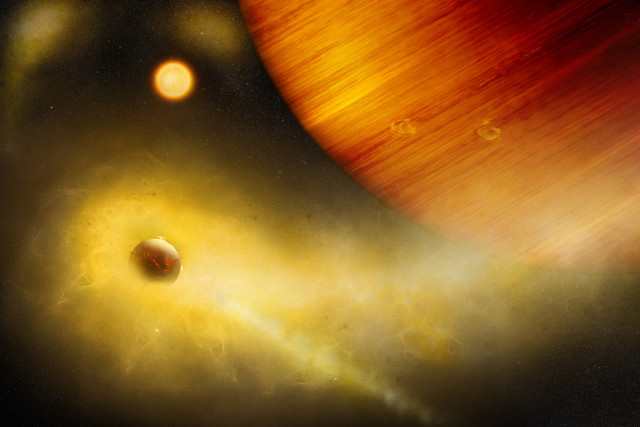
Artist's concept of an exo-Io orbiting a hot Jupiter (Image courtesy University of Bern. Illustration Thibaut Roger)

An article accepted for publication in “The Astrophysical Journal” reports on traces of sodium and potassium in the orbit of the gas giant exoplanet WASP-49b. A team of researchers coordinated by the Swiss University of Bern compared the situation of WASP-49b to Jupiter and its moon Io, known for its remarkable volcanic activity, noting that there are important clues to the fact that WASP-49b also has a volcanic moon with an activity that includes the ejection of sodium and potassium.

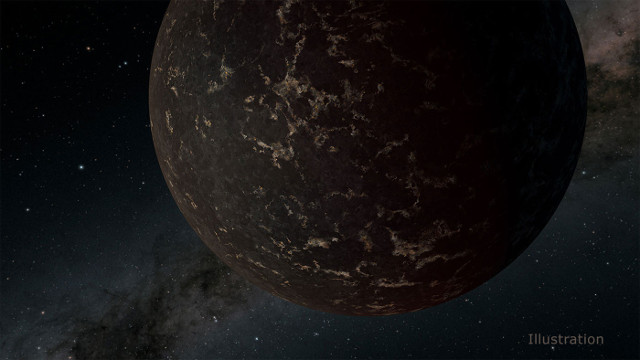
Artist's illustration of the exoplanet LHS 3844b (Image NASA/JPL-Caltech/R. Hurt (IPAC))

An article published in the journal “Nature” reports a study of the exoplanet LHS 3844b, a super-Earth discovered in 2018 thanks to NASA’s TESS space telescope. For this targeted study, a team of researchers led by Laura Kreidberg of the Harvard and Smithsonian Center for Astrophysics used the Spitzer space telescope to examine its surface and see if it had an atmosphere. The result is that LHS 3844b probably doesn’t have an atmosphere or it’s very thin and is perhaps covered by materials of volcanic origin such as the lunar “mare”. In essence, more than a super-Earth it could be a super-Mercury.