Planets

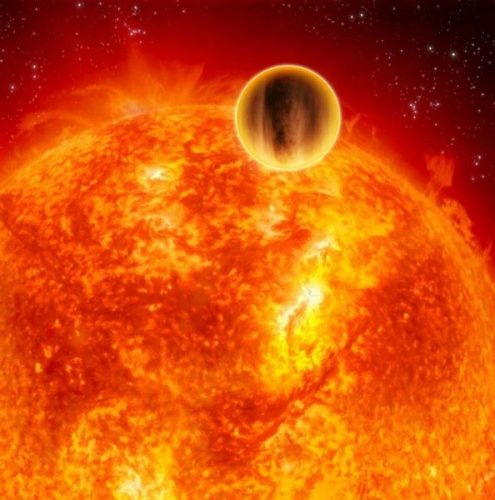
Artist's concept of exoplanet near its star (Image ESA)

An article published in “The Astrophysical Journal” reports the study of exoplanets that orbit two red giant stars: HD 212771 and HD 203949. A team of researchers led by Tiago Campante of the Instituto de Astrofísica and Ciências do Espaço (IA) of the University of Lisbon, Portugal, applied the astrosismology technique to observations conducted with NASA’s TESS space telescope. The result was surprising in the case of the HD 203949 system because the planet wasn’t swallowed by the star during its expansion even though it orbited very close to it.

Asteroid Hygiea is spherical and could be reclassified as a dwarf planet

An article published in the journal “Nature Astronomy” reports a study of asteroid Hygiea that shows its roughly spherical shape, one of the requirements to be cataloged as a dwarf planet. A team of researchers led by Pierre Vernazza of the Laboratoire d’Astrophysique of Marseille, France, used the SPHERE instrument mounted on ESO’s VLT in Chile to obtain detailed images of one of the largest objects in the asteroid belt between Mars and Jupiter. If Hygiea were reclassified, it would be the smallest dwarf planet with a diameter that is less than half that of Ceres.

Artist's concept of a planetary collision in the BD +20 307 system (Image NASA/SOFIA/Lynette Cook)

An article published in “The Astrophysical Journal” reports a study of the BD +20 307 binary system in which the presence of dust too warm to be the equivalent of the Kuiper belt was detected, therefore they have been interpreted as the remains of a planetary collision. A team of researchers led by Maggie Thompson of the University of California at Santa Cruz used the SOFIA flying telescope to detect infrared emissions, which increased over time.

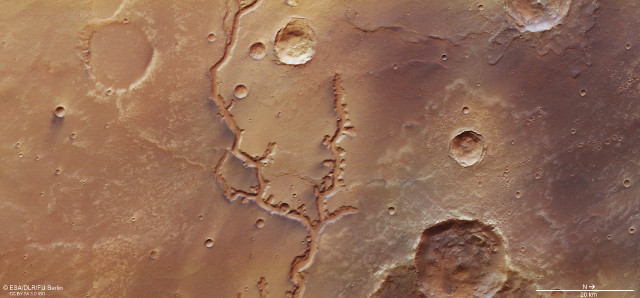
Nirgal Vallis on Mars (Image ESA/DLR/FU Berlin, CC BY-SA 3.0 IGO)

ESA has released new images captured by its Mars Express space probe’s High Resolution Stereo Camera (HRSC) showing Nirgal Vallis on the planet Mars. It’s a river valley that extends for over 700 kilometers, so vast that it crosses the Coprates and Margaritifer Sinus quadrangles. A few billion years ago, when the rivers were filled with liquid water, they probably filled Holden Crater, making it a lake with a diameter of about 150 kilometers and a depth of up to about 250 meters.

Traces of ancient salty ponds at the bottom of Gale Crater on Mars

An article published in the journal “Nature Geoscience” reports the results of an analysis of data collected by the Mars Rover Curiosity in a section of sedimentary rocks of Gale Crater on Mars called Sutton Island where salt was detected in the form of mineral salt in the sediments. A team of researchers led by William Rapin of Caltech interpreted that presence as evidence that about 3.5 billion years ago there were salty ponds that went through episodes of overflow and drying. The deposits show the history of climatic fluctuations in the period in which the Martian environment passed from wet and similar to the Earth to today’s dry desert.