
Planets

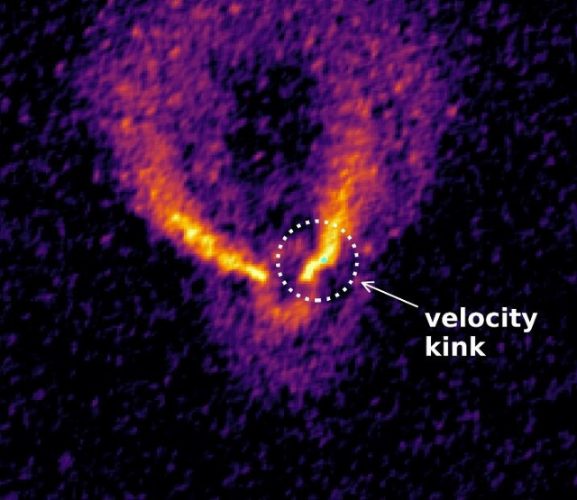
Planet's position pinpointed by the gas flow deviation (Image ESO/ALMA)

An article published in the journal “Nature Astronomy” reports the discovery of evidence of the existence of a planet in formation within the protoplanetary disk surrounding the star HD 97048. A team led by Christophe Pinte used a technique that was tested in a previous occasion that identifies areas where the flow of gas around a star is disturbed by the presence of a planet. The data collected using the ALMA radio telescope made it possible to identify a planet with a mass estimated between two and three times Jupiter’s.

In ancient times there was a dynamic environment in Gale Crater on Mars

NASA has provided an update of its Mars Rover Curiosity’s activities in what was called a clay-bearing unit of ​​Mount Sharp on Mars. Clay is associated with water, so the goal of current research is to offer new information to reconstruct the history of Mars, in this case of Gale Crater, where in ancient times there was a lake and now there’s Mount Sharp. Lately, Curiosity has been working near an outcrop that was named “Teal Ridge” and near a rock that was named “Strathdon”, formed by dozens of sedimentary layers that suggest a more dynamic environment than other typical lake sediments.

The Gl 357 system (Image NASA's Goddard Space Flight Center/Chris Smith)

An article published in the journal “Astronomy & Astrophysics” reports the discovery of three exoplanets in the system of the red dwarf GJ 357. A team of researchers led by Rafael Luque of the Canary Islands Astrophysics Institute identified the innermost exoplanet, named GJ 357 b, thanks to the observations conducted by NASA’s TESS space telescope while the other two, named GJ 357 c and GJ 357 d, were discovered using the radial velocity method thanks to data collected over twenty years of observations of various ground-based telescopes. The three exoplanets could all be rocky and the outermost is within ​​its star system’s habitable zone.

A representation of the main characteristics of the TOI 270 system's exoplanets (Image NASA’s Goddard Space Flight Center/Scott Wiessinger)

An article published in the journal “Nature Astronomy” reports the discovery of three exoplanets in the system of the red dwarf indicated in the research as TOI (Tess Object of Interest) 270 because it was studied using NASA’s TESS space telescope. They’re a super-Earth and two mini-Neptunes, all with orbits very close to their star. A team of researchers used observations made by TESS and follow-up observations with other telescopes to confirm the existence of the three exoplanets and provide some estimates of their characteristics, useful also because the two mini-Neptunes could provide information to understand the mechanisms of formation of planets of that type but also of rocky ones.

Artistic representation of a gaseous planet in a binary system (Image NASA/JPL-Caltech/T. Pyle)

An article published in “The Astrophysical Journal Letters” reports the discovery of a gaseous exoplanet in the DS Tuc binary system thanks to the use of NASA’s TESS space telescope. A team of astronomers coordinated by Dartmouth College, New Hampshire, USA, conducted this research on the exoplanet named DS Tuc Ab, which has an estimated age of about 45 million years, a sort of preteen. It has completed its growth but it’s still in a phase in which changes take place, all useful information to understand the formation and evolution of the planets.