Planets

Artist's concept of the exoplanet 55 Cancri e and its star (Image NASA/JPL-Caltech)

An article published in the magazine “The Astronomical Journal” describes a research on the exoplanet 55 Cancri e. This super-Earth is one of the most studied among the planets in other solar systems but its extreme characteristics and the often experimental nature of the studies carried out provided partial and sometimes contradictory results. Now a analysis of data gathered using NASA’s Spitzer Space Telescope convinced a team of researchers that 55 Cancri e has an atmosphere and could have a composition similar to that of the Earth.

Pluto and its atmosphere (Image NASA/JHUAPL/SwRI)

An article published in the journal “Nature” describes a research on the haze present in the atmosphere of the dwarf planet Pluto’s and its effects on its temperatures. According to a team led by Xi Zhang of the University of California at Santa Cruz, the haze absorb the already low heat from sunlight and emits infrared radiation cooling the atmosphere. That’s the explanation for the fact that NASA’s New Horizons space probe measured a temperature even lower than expected.

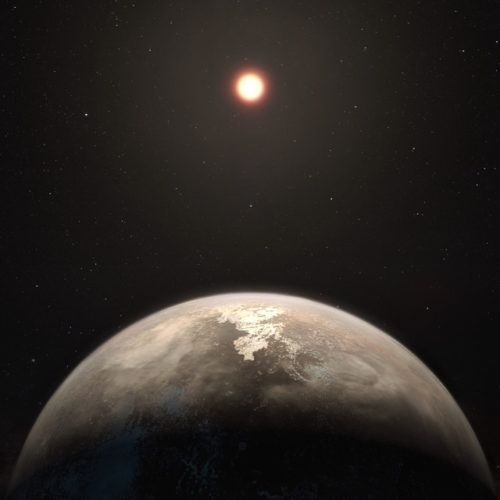
Artist's impressione of the exoplanet Ross 128 b and its star (Image ESO/M. Kornmesser)

An article published in the journal “Astronomy & Astrophysics” describes the discovery of the exoplanet Ross 128 b, which might be similar to Earth with a mass of at least 35% higher than the Earth’s. A team of researchers used the HARPS instrument at the Silla Observatory in Chile to discover this planet about 11 light years from Earth. Its orbit might be in ​its system’s habitable zone making it the second exoplanet closest to the solar system with those characteristics after Proxima b.

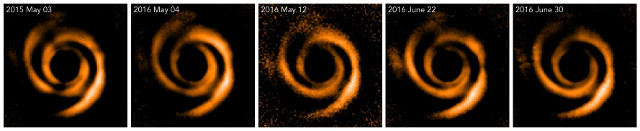
The HD 135344B system

An article published in the magazine “The Astrophysical Journal” describes a research on the protoplanetary disk surrounding the star HD 135344B. A team led by Tomas Stolker of the ETH in Zurich, Switzerland, used the SPHERE instrument mounted on ESO’s VLT (Very Large Telescope) to monitor the evolution of that dust and gas disk and of the dark bands that appear as shadows projected on it. Probably there are processes in the disk’s inner area that cause shadows on its outer area.

Vera Rubin Ridge panorama (Image NASA/JPL-Caltech/MSSS/ASU)

NASA has published a series of images taken by its Mars Rover Curiosity in the Gale Crater area of Mars called the Vera Rubin Ridge created putting together photos taken using filters that allow the mission scientists to identify some minerals. The instruments that have this capability are the MastCam (Mast Camera) and ChemCam (Chemistry and Camera). On this occasion, the MastCam allowed to highlight an iron oxide called hematite.